
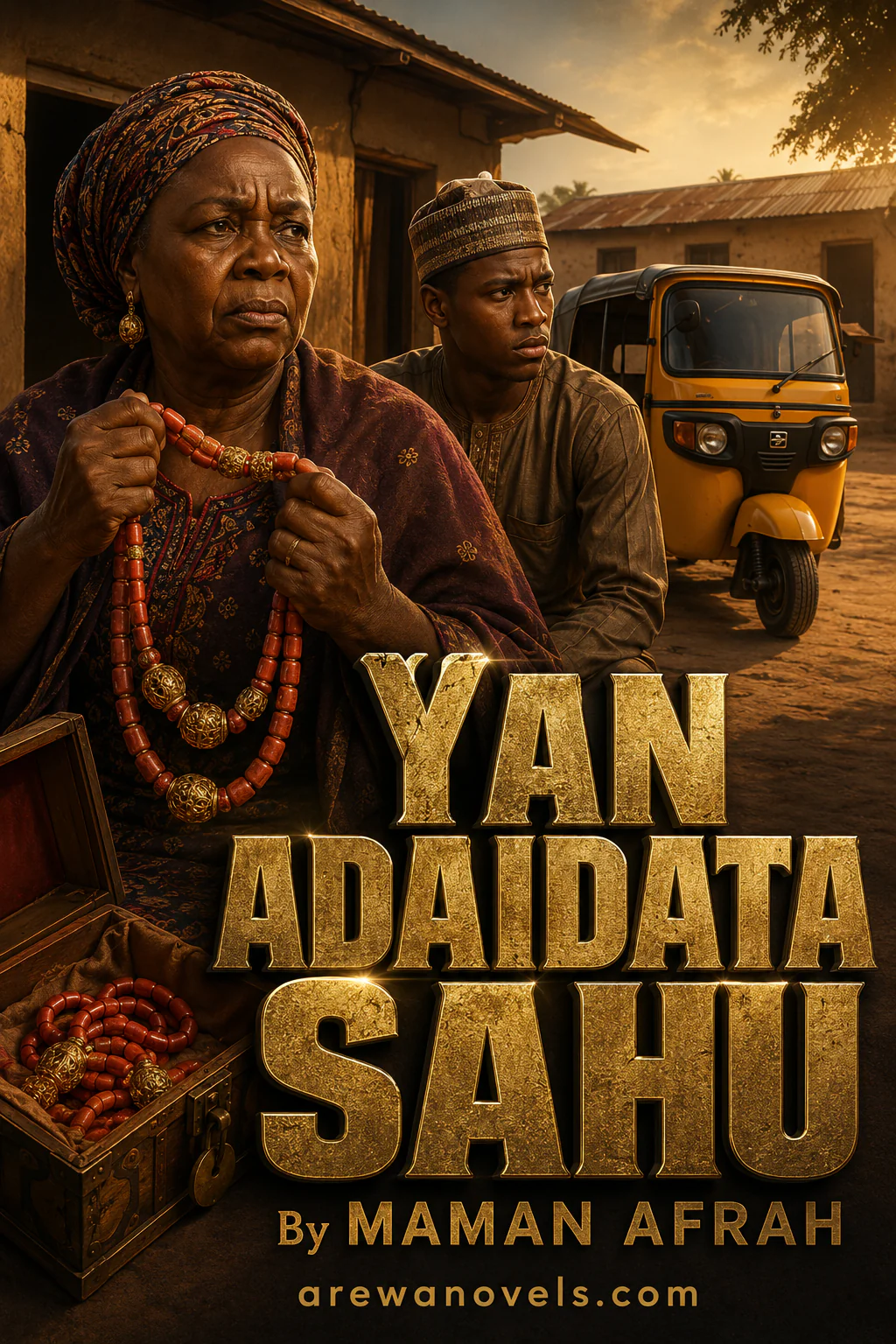
ƳAN ADAIDATA SAHU By MAMAN AFRAH
More book details
Description & Story Guide
ƳAN ADAIDATA SAHU
What Awaits You
What begins as a grandmother's desperate promise to fulfill an orphan's dream soon turns into a dangerous journey of greed, deception, and unexpected trouble. Iya Ansai is determined to sell an old coral necklace that has remained hidden among her possessions for years, believing its value could transform Jabiru's life. But when an object carrying so much history suddenly becomes the center of everyone's attention, the question is no longer simply whether it can buy a tricycle. The real question is who can be trusted when money finally enters the picture.
Summary
Jabiru is an eighteen-year-old orphan whose mind has become completely occupied by one particular dream: owning an adaidaita sahu, a commercial tricycle that he believes could give him a means of earning a living. His obsession has grown so strong that he even talks about the vehicle in his sleep. For Iya Ansai, the elderly woman who has taken the place of both mother and father in his life, watching him suffer because he cannot afford one is painful. She sees his desire as more than youthful ambition. To her, it is a chance for the young orphan to escape dependence and build a future for himself.
Unable to raise the necessary money through ordinary means, Iya Ansai remembers a valuable coral necklace that has been hidden away since the time of her marriage. She believes the necklace is worth far more than ordinary gold and decides that selling it could provide Jabiru with much more than a tricycle. In her imagination, the money could buy him land, fund the construction of a house, and even help him get married. Her generosity toward Jabiru is sincere, but her determination is mixed with an almost comic confidence in the enormous fortune she believes the necklace will bring.
The morning after making her promise, Iya Ansai gathers her sons, Baba Mamman and Baba Umaru, for a secret discussion. Her unusual behavior immediately makes them suspicious. She orders them to close the door, fetch a powerful flashlight, and make certain nobody is watching them. When she finally reveals the necklace, the reaction is not what she expects. Instead of seeing the priceless treasure she imagines, her sons question whether anyone would actually pay a substantial amount for such an old piece of jewelry. Their doubts infuriate her, especially when Umaru suggests that it might be worth little more than the price offered by scrap dealers.
Determined to prove everyone wrong, Iya Ansai decides to sell the necklace herself. She leaves home carrying the hidden treasure, imagining the moment she will return with enough money to fulfill every promise she has made. Jabiru is left behind, excited and confident that his long-awaited dream is finally within reach. But Iya Ansai's first stop is a local dealer, and the reaction she receives immediately threatens to shatter the enormous expectations she has built around the necklace.
What follows promises to turn an apparently simple attempt to help an orphan into a much bigger and more unpredictable adventure. Behind Iya Ansai's stubbornness lies a lifetime of memories, family tensions, exaggerated expectations, and a fierce love for the boy she refuses to regard as truly motherless. At the same time, the people surrounding her cannot ignore the possibility that the necklace may be worth far more than they understand. As money, suspicion, and opportunity begin to collide, the fate of Jabiru's dream becomes tied to the mysterious value of an old piece of coral jewelry.
Description
ƳAN ADAIDATA SAHU is a Hausa family drama with strong elements of comedy, everyday social life, suspense, and financial intrigue. The story is rooted in a traditional family environment where elders command respect, family members live closely together, and even ordinary household conversations can become sources of conflict and laughter. The setting feels intimate and familiar, moving between the family compound, private rooms, the mosque and the surrounding marketplace environment.
The story's strongest atmosphere comes from the contrast between serious circumstances and Iya Ansai's wonderfully dramatic personality. Her concern for Jabiru is genuine, but her blunt speech, quick temper, exaggerated reactions, and colorful observations create much of the novel's humor. The result is a story that can move from emotional concern to laughter within the same scene, while still maintaining an underlying question about whether Iya Ansai's treasured necklace will actually deliver the fortune she expects.
Core Themes
At the heart of the story is family responsibility. Iya Ansai refuses to treat Jabiru as someone abandoned by fate. She repeatedly insists that although he has lost his mother, he is not truly without a parent because she considers herself responsible for him. Her determination shows how family bonds can extend beyond biological relationships.
Another important theme is sacrifice. Iya Ansai is willing to part with something she has preserved for many years because she believes Jabiru's future is more important than her attachment to material possessions. Her actions raise an important question about how far someone should go to fulfill a promise made out of love.
The novel also explores the danger of assumptions about wealth. Iya Ansai is convinced that the necklace is extraordinarily valuable, while the people around her are far less certain. This difference in perception becomes a major source of tension and comedy. The story therefore invites readers to wonder whether the necklace is truly a hidden fortune or simply an object whose sentimental value has become greater than its financial value.
There is also a clear theme of greed and temptation. Once the possibility of great wealth appears, people's attitudes begin to change. Even the dealer who receives Iya Ansai's necklace starts imagining what could be gained from it. The story suggests that the arrival of valuable property can reveal hidden intentions that ordinary circumstances keep concealed.
Finally, the story carries a theme of hope and survival. Jabiru's dream of owning a tricycle represents his desire to become independent. For him, the vehicle is not merely transportation. It represents work, dignity, income, and the possibility of creating a future of his own.
Key Characters
Iya Ansai is the emotional center of the story. She is an elderly woman with a fierce personality, a sharp tongue, a strong sense of responsibility, and an enormous heart. Her relationship with Jabiru demonstrates the depth of her affection for him. She can be argumentative and hilariously blunt, but beneath her constant complaints is a woman prepared to sacrifice her own possessions for the sake of someone she considers her child.
Jabiru is an eighteen-year-old orphan whose greatest immediate ambition is to own an adaidaita sahu. His obsession with the vehicle has become almost comical, especially because he dreams about it even while sleeping. Yet his desire is understandable because he sees the tricycle as a path toward earning money and becoming self-reliant. His relationship with Iya Ansai also reveals his dependence on the woman who has stepped into the role of his parents.
Baba Mamman is one of Iya Ansai's sons. He is more cautious about his mother's claims concerning the necklace and appears genuinely uncertain about its supposed value. His reactions help expose the gap between Iya Ansai's expectations and the family's doubts.
Baba Umaru is another of Iya Ansai's sons. Like his brother, he questions the supposed value of the coral necklace, but his attempt to explain his concerns earns him the full force of his mother's anger. His interactions with Iya Ansai contribute heavily to the story's comic family dynamic.
The Dealer becomes important when Iya Ansai finally takes the necklace to someone who might know how to sell it. Her initial excitement about the possible fortune creates an interesting reversal when the dealer does not respond with the admiration or enthusiasm she expected. Her reaction introduces a new layer of uncertainty surrounding the necklace.
Analytics and Insight
The story succeeds particularly well through its character-driven humor. Rather than depending entirely on dramatic events, it creates entertainment through personality, family arguments, misunderstandings, and the exaggerated confidence of Iya Ansai. Her conversations with her sons provide comic relief while simultaneously moving the central plot forward.
The necklace functions as more than a valuable object. It becomes the story's central symbol of hope, sacrifice, expectation, and uncertainty. To Iya Ansai, it represents the solution to almost every problem in her household. To her sons, its actual worth is questionable. To Jabiru, however, its importance is much simpler: it could finally make his dream possible.
Another compelling element is the story's use of anticipation. Readers know that Iya Ansai is carrying something she believes could make her wealthy, but they do not know what will happen once she attempts to sell it. That uncertainty creates a natural suspense that encourages readers to continue.
The story also balances emotional depth with comedy. Iya Ansai's determination comes from genuine affection for Jabiru, but her dramatic manner turns even serious family discussions into entertaining scenes. This combination gives the novel a distinctly lively atmosphere while keeping the reader emotionally invested in Jabiru's future.
A Memorable Line
“I am his mother and his father.”
That sentiment captures the emotional foundation of Iya Ansai's relationship with Jabiru. Her promise is not merely about buying him a machine. It is about refusing to allow the boy she loves to feel abandoned by life.
Why Readers Will Want to Read It
ƳAN ADAIDATA SAHU combines family comedy, emotional storytelling, village and household dynamics, financial suspense, and the mystery surrounding an apparently valuable piece of jewelry. Readers will find themselves wondering whether Iya Ansai's confidence is justified, whether Jabiru will finally receive the vehicle he dreams about, and what will happen when different people begin to recognize the possible value of the necklace.
At the center of everything is an elderly woman who is willing to risk her treasured possession for a young orphan she loves as her own child. Her journey begins with a simple promise, but the moment the necklace leaves her house, that promise opens the door to greed, disappointment, opportunity, and perhaps a fortune none of them fully understand yet.
Read or download this novel
Choose the option available for your account and this book.
Related Novels
- MASARAUTAR QAMAR Sirrin Sarauniya Book 2 By Khadija (KMU) -
- Ƙanwar Maza Complete Hausa Novel by Aisha Adam - Aisha Adam Cool
- Deen Marshal Complete Hausa Novel by Mamuhgee - MaMuhgee
- LU'U LU'U Zuciya Mai Haɗari BOOK 02 By HUGUMA -
- ZAGON ƘASA Daga Cikin Ganuwa By KHADEEJA CANDY -
- Ƙanwar Maza Book 3 & 4 Complete Hausa Novel by Aisha Adam - Aisha Adam Cool
- Harijin Tsoho Complete Hausa Novel by Zahra M Surbajo -
- FAMILY DOCTORS: Yaƙin Iyali by Oummu Ɗahirah -
- MAKAHO NE By Maman Ihsan ce -
- Abu-Turaab Fadan Zuciya da Karfi by Asmy B -
- ABULLE ANNOBA Inuwar Mutuwa By Mss Flower -
- Kiɗa A Ruwa Complete Hausa Novel by Bilyn Abdull -