
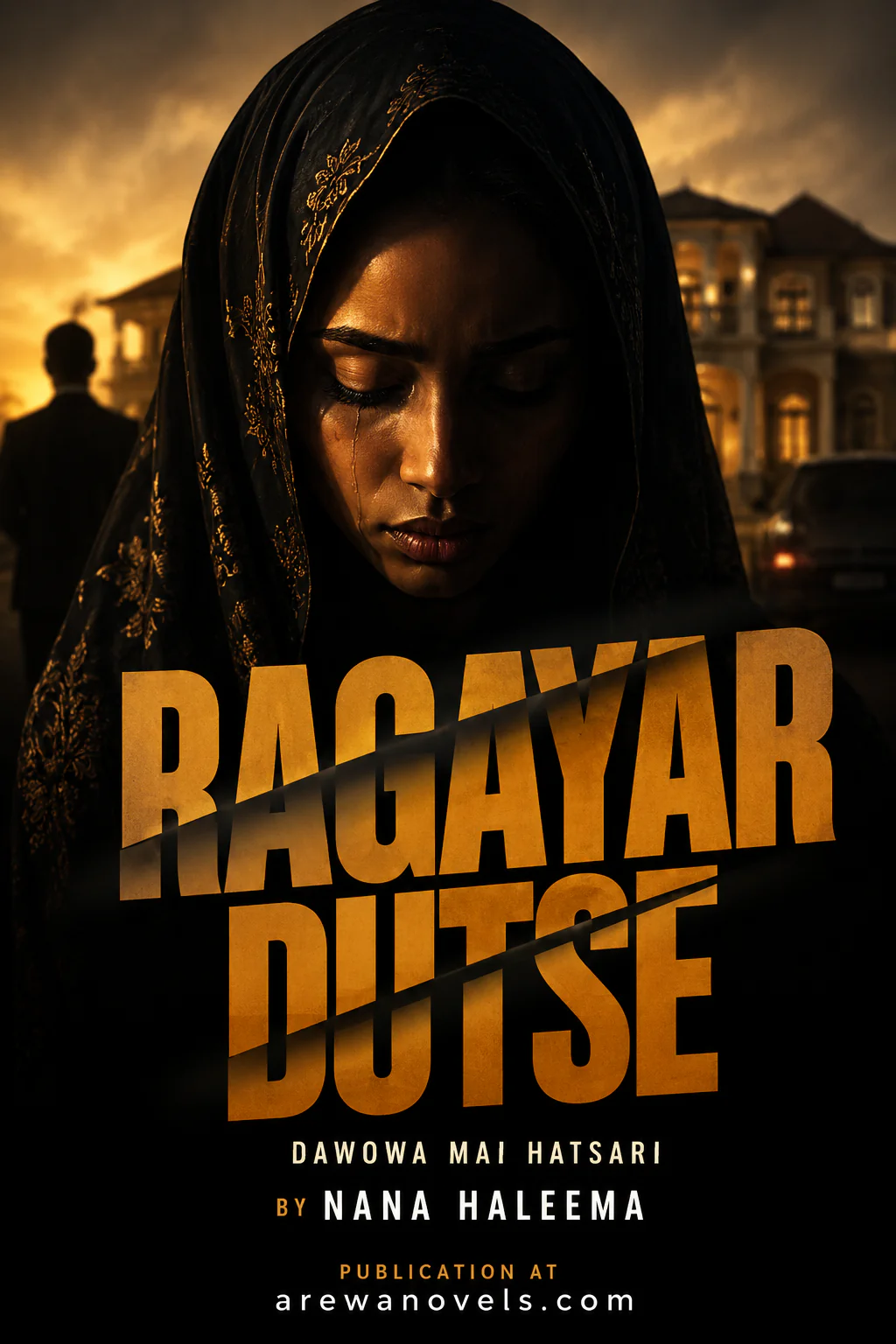
RAGAYAR DUTSE Dawowa Mai Hatsari book 1 By Nana Haleema
More book details
Description & Story Guide
RAGAYAR DUTSE
By Nana Haleema
Hook
Some families hide their secrets behind expensive walls. Some bury them beneath wealth, influence, and family names. But there are secrets that refuse to remain buried.
In Yola, several lives are moving toward a collision that none of them can see coming. A young orphan is trapped in a home where she is treated as an outsider despite the love of the man who intends to marry her. A wealthy family is preparing for the return of a son whose success has become a source of jealousy among his own relatives. And somewhere in the shadows, a dangerous network is quietly selecting young girls for a future they have been deceived into believing will bring them prosperity.
At the centre of it all is Rehaan, a young businessman whose success abroad has made him the pride of some and the greatest threat to others. His family wants him home, but not necessarily because they miss him. Some want to control him. Some want to reshape his future. Others fear what his return might expose.
And while these battles unfold, another young woman, Islaha, is fighting a completely different war. She has no powerful family name to protect her, no parents to defend her, and no safe place to run. Her only shield is the man who loves her. But even that love may not be enough to protect her from the people who have already decided what her life should become.
Summary
RagayAR Dutse opens with a deeply emotional mystery surrounding a young girl who is being taken away from her mother. The circumstances are painful enough to suggest that something terrible may happen if the child remains where she is. Her mother reluctantly entrusts her to another person, begging him to protect, educate, and raise her properly. The farewell becomes even more haunting when the mother promises that she will one day return for her daughter, only to collapse immediately afterward. This opening establishes one of the novel's most important questions: what happened to this child, and what does her past have to do with the events that will unfold years later?
The story then moves to Yola, where another battle is taking place inside a seemingly ordinary family. Maimuna is being persuaded to leave her marriage and travel to Saudi Arabia for domestic work, encouraged by a woman known as the Woman Leader. The conversation exposes the complicated pressures placed on women who want financial independence while still being expected to live according to the decisions of husbands and families. At the same time, Islaha returns from her work as a journalist and enters a household where she is constantly reminded that she is an outsider. Although she is intelligent, beautiful, confident, and professionally successful, her lack of biological parents and family connections is repeatedly used against her.
Islaha's relationship with Saheer provides one of the story's more tender contrasts. Saheer loves her and intends to marry her despite the hostility she faces from his mother. To Islaha, he is more than a future husband. He has been her protector, confidant, and closest connection to the family she never had. Yet his mother's resentment toward her grows stronger because she believes Islaha is taking her son away from her. What begins as domestic tension gradually becomes something more dangerous, especially as accusations, manipulation, and financial pressure are used to keep Islaha under control.
Elsewhere, inside the wealthy household of Alhaji AbdulAziz Zubair, another conflict is rapidly developing. His son Rehaan has built an impressive life abroad and has become one of the youngest wealthy businessmen attracting attention across Africa. Instead of celebrating his success, some members of his family see it as a threat. Saddiqa, one of the powerful women in the household, is particularly disturbed by Rehaan's growing influence because she wants her own children to remain at the top of the family hierarchy. She joins forces with Daada, the formidable matriarch of the family, to bring Rehaan back to Nigeria. What Rehaan does not know is that his return is being planned by people whose intentions are far from simple.
The situation becomes even more complicated because Rehaan's mother, Nadira, is not a Fulani woman. Her Indian background has made her a target of resentment within the family, and the hostility directed at her has extended to her son. While others accuse Rehaan of abandoning his family and losing his culture abroad, Nadira fears something much more personal. She remembers that whenever Rehaan returns to Nigeria, something seems to go wrong. Her greatest fear is not his success, his business, or his refusal to marry. It is the possibility that bringing him home may place him in danger.
Meanwhile, an even darker storyline is developing away from the wealthy family. A group of young girls from an orphanage are being recruited with promises of a better life, education, money, travel, and opportunities abroad. They are made to believe that they are being given a chance to escape poverty. Behind those promises, however, lies a secret operation involving wealthy and influential people who are prepared to exploit their vulnerability. Jamila, one of the women involved in selecting the girls, understands exactly what is happening. She is willing to manipulate, deceive, and silence anyone who threatens the operation. Islaha has already become a problem for them, and now Hafsa has attracted the attention of someone powerful enough to offer millions of naira for access to her.
As these storylines begin to move closer together, the novel creates a world where wealth does not necessarily mean safety, family does not always mean protection, and a person's greatest enemy may be someone sitting at the same table. Rehaan is being pulled back toward a family determined to control his future. Islaha is struggling to survive in a household that questions her worth. Nadira is fighting to protect her son from forces she does not fully understand. And vulnerable young women are being drawn into a scheme whose consequences could be devastating.
The question is not simply whether the characters will survive the conflicts surrounding them. The greater question is what will happen when the secrets connecting these worlds finally come to light.
Genre
RagayAR Dutse combines elements of family drama, psychological suspense, social drama, romance, mystery, and crime-oriented intrigue. The novel moves between intimate household conflicts and a much larger hidden world involving wealth, influence, exploitation, and manipulation.
Its dramatic strength comes from the contrast between ordinary family arguments and much more serious threats developing behind the scenes. A disagreement between a mother and daughter can reveal a deeper struggle for control, while an apparently generous opportunity can conceal something sinister.
Setting
The story is strongly rooted in northern Nigeria, particularly Yola, Adamawa State, where several of the major family and social conflicts take place. The setting gives the novel a distinctly northern Nigerian atmosphere, with extended family structures, cultural expectations, marriage negotiations, social status, and questions of identity influencing the characters' decisions.
The story also extends beyond Nigeria. Rehaan's life and business connections in England represent a different world from the family environment waiting for him in Nigeria. Saudi Arabia also becomes part of the narrative through discussions surrounding overseas domestic work and the promises of financial opportunity.
These different locations help create an important contrast between tradition and modernity, family expectations and personal independence, and the opportunities available outside Nigeria versus the obligations waiting at home.
Core Themes
Family, Power, and Control
One of the strongest themes in RagayAR Dutse is the struggle for control within families. Several characters believe that being a parent, elder, spouse, or family leader gives them the right to determine another person's future. Rehaan's family wants to decide where he should live, whom he should marry, and how he should conduct his life. Islaha experiences a similar struggle in Saheer's household, where her future is constantly discussed as though she has no authority over it.
The Price of Success
Rehaan's success becomes both a blessing and a source of danger. His wealth and reputation should make his family proud, yet they instead create jealousy and resentment. The novel examines how success can change relationships when people begin to measure one another through money, influence, and social position.
Orphanhood and Belonging
Islaha's position as an orphan is central to her emotional journey. Although she has built a career and developed confidence, she continues to be reminded that she does not have biological parents standing behind her. Her struggle is not simply about finding love. It is about finding a place where she can finally feel that she belongs.
Women's Independence
The conversations surrounding Maimuna, Saudi Arabia, marriage, employment, and financial independence introduce questions about the choices available to women. The novel does not present independence as a simple issue. Instead, it explores the tension between a woman's desire to control her own future and the expectations imposed by marriage, family, and society.
Prejudice and Identity
Nadira's experience exposes the consequences of judging people according to ethnicity, nationality, and cultural background. Her marriage into the family does not erase the fact that some relatives continue to see her as an outsider. The same prejudice threatens to influence the future of her children.
Exploitation of Vulnerability
The storyline involving the orphanage introduces one of the novel's darkest themes. Young women who believe they are being offered education, money, travel, and a better future are instead being targeted by people who see their vulnerability as an opportunity. The contrast between the promises made to the girls and the intentions of those recruiting them creates some of the novel's strongest suspense.
Love Versus Possession
Saheer genuinely cares for Islaha, but his relationship with her exists within a household where love is constantly being challenged by possessiveness and control. Similarly, the family members who claim to be acting for Rehaan's benefit may actually be motivated by jealousy and personal ambition. The novel repeatedly asks whether love remains love when it becomes an excuse to control another person's choices.
Key Characters
Islaha
Islaha is a young journalist whose beauty, intelligence, confidence, and professional ability have made her noticeable in the public sphere. She is courageous and outspoken, but her confidence can sometimes turn into impulsiveness. Having grown up without biological parents, she understands what it means to fight for a place in the world.
Despite her strength, Islaha is emotionally vulnerable because of the hostile environment in which she lives. She tolerates humiliation largely because of Saheer, the man who has stood by her when others rejected her. Her journey promises to become increasingly difficult as the problems surrounding her extend beyond domestic conflict.
Saheer
Saheer is Islaha's protector, confidant, and intended husband. He genuinely cares for her and wants to build a life with her away from the hostility she experiences in his mother's home. His greatest challenge is balancing his love for Islaha with his loyalty to his mother.
His position places him directly between two powerful emotional forces, and the more his mother sees Islaha as a threat, the harder it becomes for Saheer to keep peace.
Rehaan
Rehaan is one of the novel's most intriguing figures. Young, wealthy, successful, and based largely abroad, he has created a reputation that extends far beyond his family. His business success has made him admired publicly but feared privately.
His return to Nigeria is presented as a major turning point. While his family describes it as a matter of duty, culture, and belonging, several characters have private motives for wanting him home. Rehaan therefore returns not simply to his family, but into a struggle that has been developing without his knowledge.
Nadira
Nadira is Rehaan's mother and one of the more emotionally complex characters in the story. An Indian-born doctor married into a Fulani family, she has spent years living with the knowledge that she is not fully accepted by some members of her husband's family.
Her greatest concern is her son's safety. Unlike those who see Rehaan primarily through his wealth and family position, Nadira sees the risks surrounding his return. Her fears suggest that there may be more behind the family's hostility than ordinary jealousy.
Saddiqa
Saddiqa is a powerful woman within the Zubair household. She is fiercely protective of her position and deeply invested in the success of her own children. Rehaan's rise therefore represents a direct challenge to the future she has imagined for her family.
She is intelligent, determined, and willing to use family alliances to achieve her objectives. Her decision to involve Daada in the plan to bring Rehaan home could have consequences far beyond what she anticipates.
Daada
Daada is the formidable matriarch whose authority dominates the family. She believes strongly in tradition, family hierarchy, and ethnic identity. Her resentment toward Nadira and her determination to control Rehaan's marriage reveal how deeply she values preserving the family's established identity.
Once Daada makes a decision, challenging it is almost impossible. Her demand for Rehaan's return therefore becomes one of the major forces driving the story.
Jamila
Jamila occupies a much darker corner of the novel. She is involved in the recruitment and manipulation of young girls who are promised opportunities and a better future. Behind her polite presentation lies someone who understands the operation she is helping to facilitate.
Her involvement places her on a collision course with Islaha and potentially anyone else who threatens the people behind the scheme.
Hafsa
Hafsa is one of the young girls who becomes important to the hidden operation. Unlike the others, she has attracted special attention from a powerful man who is willing to pay an enormous amount of money to obtain access to her.
Her vulnerability makes her situation particularly dangerous, while her connection to Islaha suggests that her fate may become a key part of the larger mystery.
Analytics and Insight
The strongest feature of RagayAR Dutse is the way its conflicts operate on different levels. On the surface, the novel contains familiar family disputes involving marriage, money, jealousy, in-laws, and parental authority. Beneath that surface, however, there are much darker forces at work.
The novel also creates suspense by withholding the full connection between its characters. Readers are introduced to several seemingly separate problems: Islaha's troubled life, Rehaan's family conflict, Nadira's fears, the overseas work discussions, and the recruitment of vulnerable girls. The possibility that these storylines may eventually intersect gives the narrative a strong sense of anticipation.
Another compelling element is the contrast between appearance and reality. Wealthy families appear respectable, but jealousy and manipulation exist behind their walls. A successful businessman appears to have everything, yet his own family may be his greatest source of danger. Young girls are promised a better future, while the people making those promises have completely different intentions.
The novel also gives considerable attention to social identity. Being an orphan, being from another country, being a woman seeking financial independence, and living between traditional expectations and modern ambitions all influence how the characters are treated. These issues make the story more than a straightforward romance or family drama.
Most importantly, RagayAR Dutse creates the feeling that several characters are walking toward consequences they cannot yet see. Rehaan does not know what awaits him in Nigeria. Islaha does not know how far the people targeting her are prepared to go. The girls being recruited do not understand the danger behind the promises being made to them. Nadira senses that something is wrong, but she may not yet know how deep the problem goes.
That uncertainty is what gives the novel its suspense.
What Readers Can Expect
Readers can expect a story filled with family politics, emotional confrontations, complicated relationships, cultural expectations, hidden agendas, wealth-driven jealousy, romantic tension, and an increasingly dangerous mystery.
The novel does not present its characters as simply good or bad. Many of them have understandable motivations, but their choices reveal their flaws. Some protect the people they love. Others protect their position. Some seek freedom. Others seek control. And some are willing to sacrifice vulnerable people for personal gain.
As the story progresses, the central conflicts are likely to become increasingly difficult to separate. The family that wants Rehaan back may discover that controlling him is not as easy as they imagined. Islaha's determination to survive may bring her closer to secrets she was never supposed to uncover. And the girls being promised a brighter future may find themselves trapped in a situation from which escape will be extremely difficult.
A Suspenseful Quote
"Some people fear losing what they have. Others fear watching someone else rise higher than them."
This sentiment captures one of the central tensions of RagayAR Dutse, where ambition, jealousy, family loyalty, and power repeatedly collide.
Final Impression
RagayAR Dutse is a layered northern Nigerian drama that begins with personal struggles but gradually opens into a much larger story of family politics, hidden intentions, exploitation, identity, and survival.
Behind every family conversation lies another conversation that has not been spoken aloud. Behind every promise may be an ulterior motive. And behind some of the opportunities presented to the vulnerable may be a danger far greater than they could ever imagine.
For readers who enjoy stories where romance exists alongside family conflict, mystery develops beneath everyday life, and seemingly unrelated characters are slowly pulled toward the same storm, RagayAR Dutse offers plenty of reasons to keep turning the pages.
Because in this story, the greatest danger may not come from the person standing outside the family.
It may already be sitting inside it.
Read or download this novel
Choose the option available for your account and this book.
Related Novels
- Yarinyar Ce Tayi Min Fyade Complete Hausa Novel by Miss Untichlobanty -
- Yarinyar Ruwa Complete Hausa Novel by Aysha Alkali Ce -
- CHEATERS CLUB Rantsuwar da Ta Karye By Surayyahms -
- ZANE A KAN RUWA Tagwayen Boye By Aysher Angel -
- THE HATED GIRL Hawayenta Sun ɓoye Gaskiya by HAUWA JIBRIN MA'AJI -
- Burin Fansa Book Complete Hausa Novel by Hauwa Isah Ja'o -
- DAGA RAINO Tushen Rikici By Amina alhasan -
- DEEN HOUSE Tsoro da Sirri By Oum Hairan -
- HARIJIN NAMIJI Sirrin Sha'awa By Oum Aphnan -
- Hadarin Gabas Book Complete Hausa Novel by Nazeefa Sabo Nashe -
- Tabarmar Kashi 1&2 Complete Hausa Novel by Safiyya Huguma -
- MATAR OGA NA Bayan Rufe Ƙofa By Ummy Aysha -