
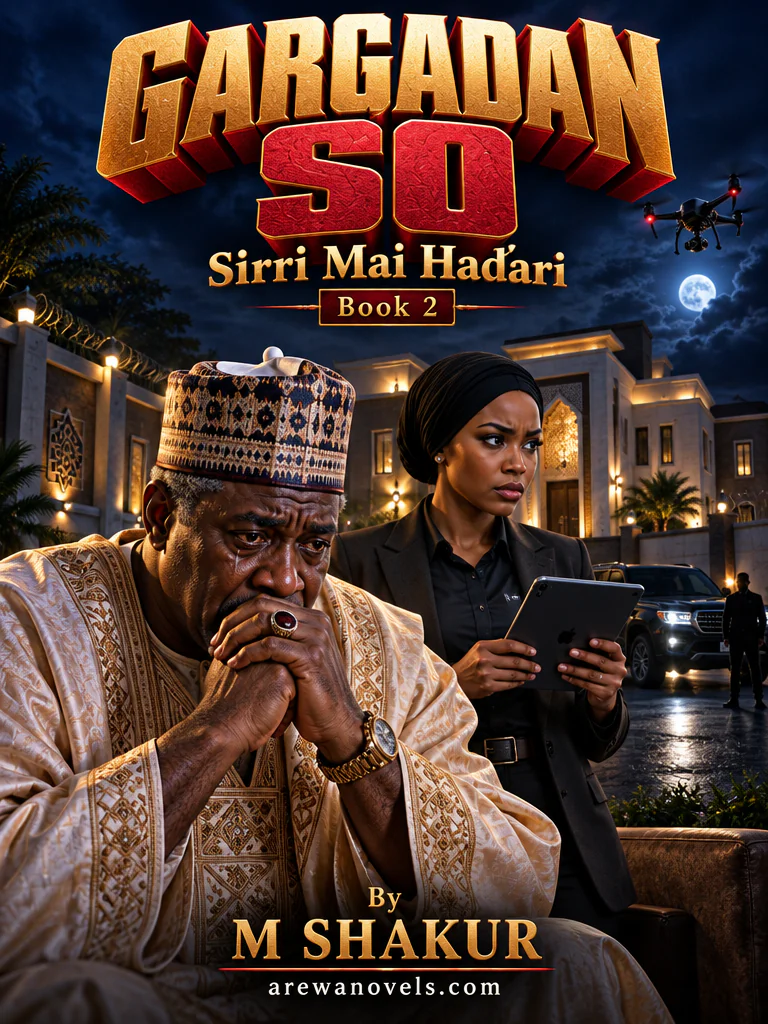
GARGADAN SO Sirri Mai Haɗari Book 2 By M SHAKUR
More book details
Description & Story Guide
GARGADAN SO Sirri Mai Haɗari Book 2
By M SHAKUR
What Awaits You
Money is often treated as the ultimate source of power, a privilege that can open every door, silence opposition, and make its owner believe that nothing is beyond reach. But what happens when wealth fails to buy peace, influence cannot guarantee safety, and a family accustomed to getting everything it wants suddenly finds itself helpless before an enemy it cannot see? In Gargadan So by M. Shakur, a terrifying kidnapping exposes the vulnerabilities hidden behind a life of extraordinary privilege, setting the stage for a suspenseful battle of intelligence, family secrets, wounded pride, and unexpected confrontations.
At the heart of the story is four-year-old Noor, an innocent little girl whose disappearance throws her wealthy family into a state of desperation. When she is abducted during an ordinary visit to the park, her family initially believes that money will solve the problem. The kidnappers demand an enormous ransom of one hundred million, and the family complies, hoping that the payment will secure Noor's immediate release. Yet the money is delivered, and the little girl remains missing. Days pass without reassurance, communication, or proof that she will return safely. For her father, Khaleel, every unanswered question becomes another source of torment. Unable to eat properly or find comfort, he struggles with the horrifying possibility that the daughter he loves so deeply might never come home.
But the crisis is complicated by the family's determination to handle everything privately. The kidnappers have warned them against involving the police, threatening that Noor could disappear forever if law enforcement becomes involved. Her grandfather, Senate President Alhassan Mangal, initially hopes that wealth, connections, and personal influence will be enough to resolve the situation. When these advantages fail, however, he faces an agonizing choice between obeying the kidnappers and risking a discreet investigation. Watching his son deteriorate under the weight of fear, he finally reaches out to the Deputy Inspector General of Police for assistance. What begins as a private family emergency soon becomes a race against time, with the authorities determined to rescue the child before the situation turns into an irreversible tragedy.
The investigation brings Miss Hawwa into the picture, a brilliant criminologist whose reputation rests on her exceptional ability to decode information, profile suspects, track criminals, and solve dangerous cases. Working alongside Hayatu and Abraham, two capable members of a specialised anti-crime task force, she is given a demanding deadline: find Noor within twenty-four hours. Her intelligence, discipline, and fearless approach make her a formidable investigator, but her assignment is far from straightforward. The powerful family surrounding the missing child is full of tension, contradictions, and uncomfortable questions. Hawwa understands that a kidnapping investigation cannot be solved by accepting appearances or allowing social status to determine who deserves scrutiny. Every person who had access to Noor, every relationship surrounding her family, and every unexplained detail must be examined before the truth can emerge.
As Hawwa begins questioning the household staff, security personnel, and women from Khaleel's complicated marital past, the investigation reveals a disturbing family dynamic. Khaleel has married and divorced several women, often within remarkably short periods, while his wealthy parents appear willing to defend his behaviour rather than challenge it. The women who once shared his home carry different grievances, and their accounts suggest a history of emotional neglect, broken relationships, and a troubling imbalance of power. Most strikingly, Noor's biological mother has been separated from her daughter for years in all but name, with limited opportunities to see the child she gave birth to. Her anger toward Khaleel and his family is unmistakable, raising difficult questions about resentment, motherhood, and the consequences of treating relationships as disposable possessions.
When Hawwa identifies Noor's mother as a suspect, the announcement sends shockwaves through the household. Khaleel, already overwhelmed by fear and frustration, reacts with fury, while his family struggles to accept that someone connected to their own history could be implicated. Yet Hawwa refuses to let intimidation, wealth, or wounded pride dictate the direction of her investigation. She must distinguish genuine evidence from emotional assumptions, determine whether old grievances have any connection to the abduction, and follow the facts even when they lead toward uncomfortable possibilities. Meanwhile, the search becomes increasingly urgent, demanding more than clever deductions. It requires courage, technological expertise, careful coordination, and the ability to act decisively when a child's life may depend on a single discovery.
Beyond the mystery itself, Gargadan So explores the dangerous consequences of unchecked privilege and the belief that money can purchase control over other people's lives. Khaleel's wealth has afforded him extraordinary comfort, but his treatment of his former wives reveals a man accustomed to getting his way without seriously considering the emotional consequences of his decisions. His parents' willingness to excuse his behaviour further complicates the picture, suggesting that wealth can create an environment where accountability becomes inconvenient and other people's pain is easily dismissed. Through these relationships, the novel invites readers to question whether financial success truly represents power when a person lacks emotional maturity, empathy, and respect for others.
Hawwa stands at the centre of this unfolding drama as a refreshing contrast to the privileged household she has been called to investigate. Highly educated, observant, composed, and professionally fearless, she relies on evidence rather than appearances. Yet her confidence does not make her immune to the pressures surrounding the case. She must navigate a family whose members are accustomed to commanding attention, while also managing her own reactions to their arrogance and dismissive attitudes. Her confrontations with Khaleel create an especially compelling tension, as neither seems willing to surrender their position easily. Their clashes introduce an additional layer of interpersonal drama into an already urgent investigation, leaving readers curious about how their relationship will develop as the search for Noor progresses.
The supporting characters add further depth to the story. Senate President Alhassan Mangal represents the conflict between public authority and private helplessness. A man whose position and resources ordinarily command respect, he discovers that neither political influence nor money can guarantee his granddaughter's safety. Khaleel, meanwhile, is a complicated figure whose genuine love for Noor exists alongside an abrasive personality and a troubling history of failed marriages. His emotional attachment to his daughter is evident, but the investigation also exposes questions about the way he treats the people around him. Noor's mother provides another important perspective, embodying the pain of a parent who has been denied a meaningful place in her child's life. Hayatu and Abraham complement Hawwa's investigative abilities with their own specialised skills, helping transform a desperate family's search into a coordinated criminal investigation.
Set against the backdrop of an affluent Nigerian household and the world of discreet law enforcement, the novel blends crime thriller, suspense, family drama, and elements of romantic tension. Its luxurious residences, powerful political connections, specialised security arrangements, and advanced investigative technology establish a world where privilege and danger exist side by side. The contrast between the family's opulent surroundings and their growing desperation reinforces the central mystery: even people who appear to possess everything can find themselves powerless when confronted with a carefully concealed threat. The investigation's twenty-four-hour deadline adds urgency, while the revelations about Khaleel's previous marriages introduce a web of personal grievances that may hold clues to the crime.
At its core, Gargadan So examines the limits of wealth, the responsibilities that accompany power, the emotional consequences of broken relationships, and the difference between suspicion and proof. It also highlights the importance of professional competence, critical thinking, and perseverance under pressure. Hawwa's investigation challenges the assumption that influential families should be protected from uncomfortable questions, while Noor's disappearance reminds readers that innocent children can become vulnerable when adult conflicts are allowed to dominate family life. The story's strongest tension emerges from the possibility that the truth may be far more complicated than the family is prepared to accept. Even when a suspect appears convincing, the investigator must establish what the evidence actually reveals.
The novel's analytical appeal lies in the way its personal conflicts intersect with its central criminal mystery. Khaleel's former wives have reasons to resent him, his family has a history of strained relationships, and Noor's mother has endured a painful separation from her daughter. These circumstances create a wide field of possible motives, but motive alone does not establish guilt. Hawwa must distinguish emotional grievances from criminal involvement and determine which details genuinely connect to the abduction. Her decision to investigate Noor's mother illustrates the uncomfortable nature of criminal profiling: even someone whose circumstances inspire sympathy may require scrutiny when the facts demand it. At the same time, the family's hostile reactions demonstrate how quickly fear can become defensiveness when familiar assumptions are challenged.
For readers who enjoy intelligent female investigators, wealthy and complicated families, high-stakes mysteries, and emotionally charged confrontations, Gargadan So offers several reasons to keep turning the pages. Hawwa's methodical approach gives the investigation a strong procedural foundation, while Khaleel's temper and the family's tangled relationships keep the personal drama unpredictable. The search for Noor also provides an emotional anchor, ensuring that the mystery is not merely about identifying a culprit but about bringing a vulnerable child home safely. As the investigation moves from questioning and profiling toward technological surveillance and a carefully coordinated rescue operation, the stakes become increasingly immediate. The possibility of discovering Noor's whereabouts raises new questions about the kidnappers' intentions, the reliability of the clues, and the risks the team must take to reach her.
One of the most compelling ideas running through the story can be expressed in this original line inspired by its central themes: “Money may command a room, influence may silence a crowd, and power may open every door, but none of them can guarantee the safety of a heart that matters.” This is not a verified quotation from the manuscript, but a thematic line capturing the conflict at the heart of the novel.
Ultimately, Gargadan So by M. Shakur presents a suspenseful combination of criminal investigation, family secrets, social privilege, and emotionally complicated relationships. Noor's disappearance sets the entire story in motion, but the questions surrounding her family give the mystery its deeper significance. Can Hawwa uncover the truth before the deadline expires? Is the person responsible hiding behind an innocent appearance, or has the family's history of broken relationships led the investigation toward the wrong suspect? And when the truth finally emerges, will Khaleel and his family be prepared to confront what it reveals about their own choices? With a determined investigator, a desperate father, a politically influential grandfather, and a little girl whose safety hangs in the balance, the story builds a compelling sense of urgency. The closer the investigation comes to its answers, the more important it becomes to separate evidence from emotion, appearances from reality, and wealth from genuine power.
Read or download this novel
Choose the option available for your account and this book.
Related Novels
- GIDAN SOLO BOOK 2 Auren Bazata By Autar alheri -
- RAMIN KURA Kursiyin Ha’inci By AmMey Laylerh -
- MAFARKI NA Mafarkin Masoya By ISHAQ N ABDALLAH -
- RUWA CIKIN COKALI Bayan Ƙofofi by Maman Afrah -
- KANWAR MAZA Farashin Ƙauna 3 and 4 by Aisha Adam Cool -
- Masarautar Mu Sirrin Zuciya part 2 by Sumayya Abdulkadir Takori -
- MATAR BAHAUSHE Auren Ba Zato by Mrs -
- FAHIMAH Soyayya da Rashin book 2 By Takori Kabara -
- HAJAR Gidan Hargitsi By Nafeesah Yusuf Nagoda -
- KUNDIN AL`AJABI Neman Ƙarfi By Mansur Usman Sufi -
- ASHAWO (KARUWAR GIDA) 'Yancin Uwa 1 by Zahra Surbajo -
- JIKAR IYA DELU Yarinyar Mamaki By Oum Yasmeen -