
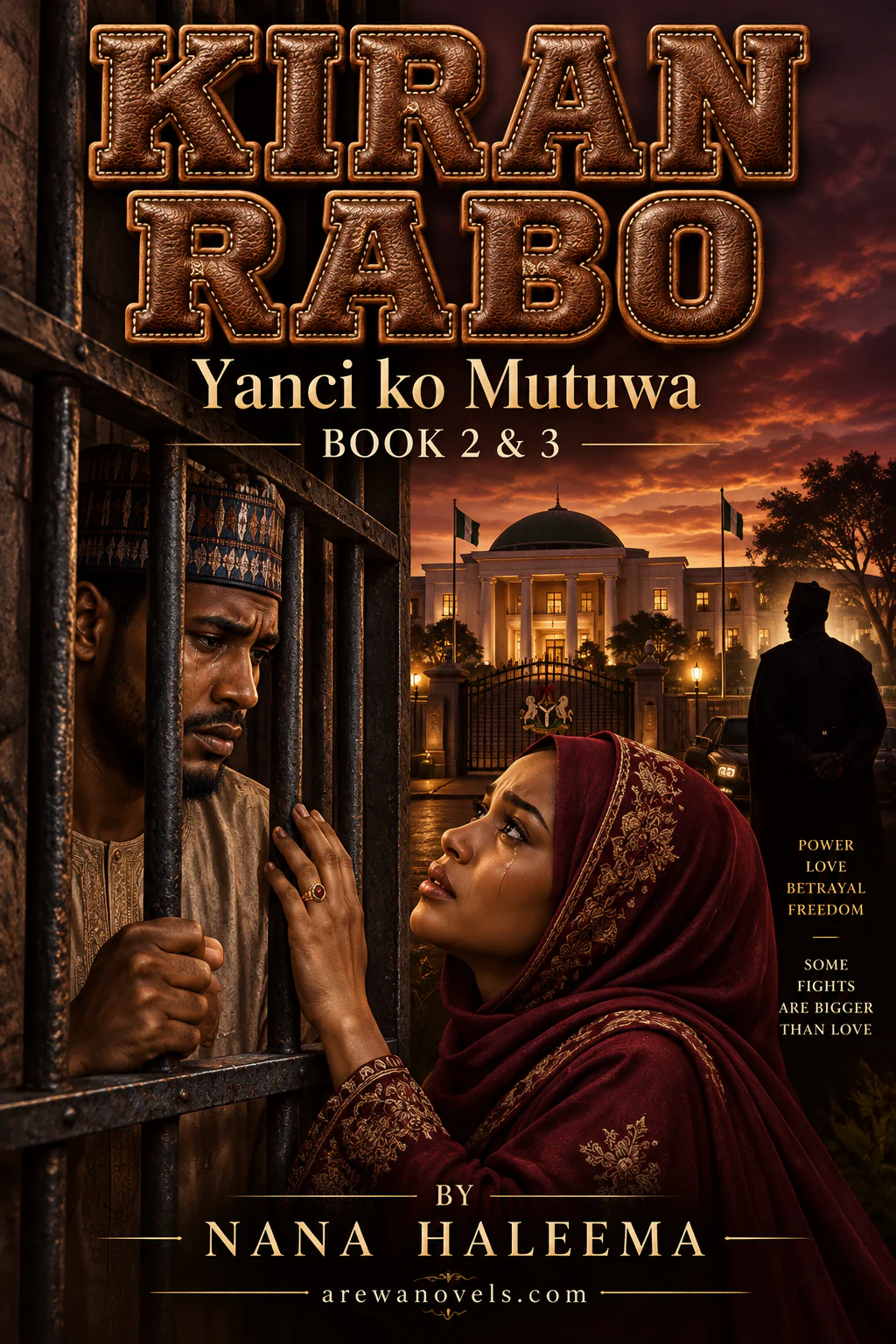
KIRAN RABO Ƴanci ko Mutuwa BOOK 2 and 3 BY NANA HALEEMA
More book details
Description & Story Guide
What Awaits You:
When Love Becomes a Crime
What happens when a man dares to love a woman whose father believes he is beneath her, and that love becomes the reason he loses his freedom? For Omar, known as Tiger, one courageous decision to seek the hand of Senator Sen Sagir's daughter transforms his life into a nightmare. He comes seeking acceptance, but leaves at the mercy of a powerful man determined to destroy him. As Omar disappears into a secret place of torture, two women are left struggling with a love neither can easily confess, a family is torn apart by grief, and revenge threatens to consume everyone involved. But with powerful enemies controlling the game, who will be brave enough to bring Tiger home, and will love still have a place in his heart when he finally returns?
Summary: A Dangerous Price for Love
Omar, popularly known as Tiger, is a man who refuses to let fear dictate his decisions. When he falls for Narma, the daughter of the influential Senator Sen Sagir, he dares to approach her family with the intention of seeking her hand in marriage. His decision, however, becomes the beginning of a devastating confrontation. Sen sees Omar's presence in his home as an insult to his status and authority, especially because he considers the young man unworthy of his daughter. Rather than handling the situation with reason, he allows his pride and anger to determine his actions. The consequences are immediate and brutal. Narma collapses amid the emotional turmoil, while Omar is seized and taken away under accusations designed to justify his punishment. Sen's determination goes far beyond having him arrested. He wants Omar to suffer so severely that he will never forget the price of daring to love his daughter.
Behind closed doors, Sen's plans become even more sinister. Unwilling to allow the law to take its course, he considers using planted cocaine and a fabricated drug-trafficking accusation to ensure Omar's imprisonment. His intention is to make the young man appear guilty while keeping his own involvement hidden. His wife, equally furious about what has happened, believes Omar has disgraced their family and blames him for Narma's deteriorating condition. Together, they begin to contemplate a future in which Omar is permanently removed from their daughter's life. Sen also decides that Narma must be sent abroad, hoping distance will separate her from the man she loves. Yet Narma refuses to accept that her feelings are merely the result of a spell or manipulation. Despite her father's insistence, she maintains that she fell in love with Omar of her own free will. Her desperation grows as she pleads for his release, even threatening to give up her own life rather than live without him.
Meanwhile, in Kano, Omar's sudden disappearance leaves his sister, Didi, overwhelmed by fear. Knowing her brother's habits, she cannot understand why he has failed to return home or answer his phone. When Bashir and Goje eventually arrive with the news that Omar has been detained through Sen's influence, her worst fears begin to take shape. Her brother has not merely been arrested. He has been placed beyond the reach of ordinary assistance, and the powerful people who might help appear reluctant to challenge the senator. Didi seeks support from Hajja, whose compassion leads her to contact people who might have a connection to Sen. AbdulHamid also promises to explore possible ways of helping, but the situation remains uncertain. When Bashir later searches for Omar in prison and discovers that no inmate by that name is registered there, the mystery deepens. If Omar is not in prison, where has Sen taken him, and what is being done to him?
While Narma fights to save the man she loves, another woman suffers silently from a distance. Nayla, who has secretly fallen for Omar, learns of his imprisonment through her sister Salma. The news shatters her composure, forcing her to confront feelings she has tried desperately to conceal. She believes that admitting her love would lead nowhere, especially because she fears her father, Abiy, would never approve of Omar as a suitable husband. Her father has already presented her with four potential suitors, including Omar, Lamin, Abbas, and Hashim, and expects her to choose one based on character, family background, education, and respectable conduct. Nayla knows her heart has already made its choice, but she cannot bring herself to reveal the truth. Her dilemma becomes even more complicated when her mother, Mama, discovers her distress and promises to support her in marrying the man she truly loves, even without knowing his identity.
As the days pass, the suffering spreads beyond Omar's immediate family. Narma's parents prepare to send her to England, while Sen considers arranging a secret marriage between her and Ashraf, the man she loved before becoming attached to Omar. They hope that a new relationship will help her forget Tiger, even as Sen continues to pursue his own cruel plans against him. Narma, however, has already found a way to reach Omar at his place of confinement. The sight of his suffering leaves her devastated, but her apology and promises cannot immediately reach him. Omar remains withdrawn, consumed by thoughts of Didi and the pain of leaving his sister alone. In Kano, Didi refuses to surrender and prepares to travel to Abuja to plead directly with Sen. Nayla, too, begins searching for a way to influence the situation. With three women connected to Omar through different kinds of love, his fate hangs in the balance. But when power protects cruelty and the truth is deliberately concealed, will any of them succeed in bringing him home?
Description: Romance, Power, and the Battle for Freedom
This Hausa romantic drama blends forbidden love, family conflict, political influence, emotional suspense, and revenge into a story about the consequences of defying social expectations. Its central conflict revolves around Omar's relationship with Narma and the devastating reaction of a father who believes wealth, reputation, and family status give him the right to determine his daughter's future. The narrative explores what happens when personal affection clashes with the authority of powerful parents, especially when pride becomes more important than justice.
The story moves between Abuja, Kano, and Kaduna, with England emerging as a proposed destination intended to separate Narma from Omar. The luxurious homes of influential families stand in sharp contrast to the secret, neglected location where Omar is held and tortured. These contrasting settings emphasize the unequal distribution of power in the characters' world. While some characters can mobilize security personnel, connections, and political influence to achieve their goals, others must depend on family loyalty, personal courage, prayer, and the uncertain goodwill of people who might intervene.
Suspense is sustained through several unanswered questions. Omar's whereabouts remain uncertain even after his disappearance is linked to Sen. His treatment behind closed doors is concealed from those desperate to save him, while his sister and friends struggle to establish where he has been taken. At the same time, the romantic conflict expands beyond Narma to include Nayla, whose hidden affection creates another emotional complication. The possibility of an arranged marriage between Narma and Ashraf introduces yet another layer of tension, leaving the future of all three relationships uncertain.
Core Themes: Love, Pride, and the Cost of Power
Love is the story's central theme, but it appears in different forms. Narma's love is outspoken and desperate, Nayla's is secretive and painful, and Didi's devotion to her brother is expressed through fear, sacrifice, and determination. These contrasting relationships reveal that love can inspire courage while also exposing people to emotional suffering. The narrative asks whether love can survive when the people who control a person's circumstances refuse to recognize it.
Pride and social status are equally important. Sen interprets Omar's marriage proposal as a personal humiliation rather than an opportunity to understand his daughter's wishes. His response exposes the destructive potential of a society in which influence and reputation can outweigh fairness. His willingness to consider fabricated criminal charges also raises questions about corruption, accountability, and the misuse of authority.
Family loyalty forms another major theme. Didi refuses to abandon Omar, even when his disappearance leaves her frightened and uncertain. Hajja offers shelter and seeks assistance on her behalf, while Mama promises to defend Nayla's right to choose her own husband. These acts of support provide a contrast to the controlling behaviour of Sen and his wife. The story also explores secrecy, sacrifice, jealousy, emotional manipulation, and the difference between protecting loved ones and controlling their lives.
Revenge threatens to overwhelm every other concern. Sen does not simply want Omar removed from Narma's life; he wants him to experience suffering comparable to the pain he believes Omar has caused. This desire raises an important question: when punishment becomes personal, can justice survive? The consequences of Sen's decisions suggest that revenge rarely affects only its intended target. Instead, it spreads distress through families, damages relationships, and creates new conflicts that may become impossible to control.
Key Characters: The People at the Heart of the Conflict
Omar, also known as Tiger: Omar is the central male character whose decision to pursue Narma brings him into direct conflict with her influential father. His boldness and determination are apparent in his willingness to seek her hand despite the social barriers between them. However, his confinement reveals a more vulnerable side. Even while enduring mistreatment, he remains deeply concerned about Didi's suffering at home. His fate becomes the central mystery driving the efforts of several characters.
Narma: Narma is Sen Sagir's daughter, a woman whose love for Omar places her in opposition to her own family. She refuses to accept her parents' belief that her feelings are the result of a spell, insisting that her affection is genuine. Her desperation grows as Omar suffers and her father refuses to release him. Her forced separation from him and the prospect of an arranged marriage to Ashraf make her struggle increasingly painful.
Nayla: Nayla is a young woman who secretly loves Omar but believes that revealing her feelings would be futile. Her fear of rejection and her father's expectations prevent her from speaking openly. The news of Omar's imprisonment intensifies her emotional turmoil and pushes her toward finding a way to help him. Her situation creates a parallel romantic conflict that may become crucial to Omar's future.
Didi, also called Aisha: Didi is Omar's devoted sister, whose world is shaken by his disappearance. She is determined to discover his whereabouts and secure his release, even if doing so means confronting the powerful senator responsible for his detention. Her desperation highlights the strength of sibling affection and the helplessness of ordinary people when they face influential adversaries.
Senator Sen Sagir: Sen is the principal antagonist in the conflict surrounding Omar and Narma. His political influence, pride, and desire to maintain family prestige shape his response to Omar's proposal. Rather than accepting the possibility that his daughter might choose a partner outside his preferred social circle, he resorts to intimidation and secret punishment. His actions place his daughter's wellbeing, Omar's freedom, and the stability of several families at risk.
Mum, Narma's Mother: Although she is deeply distressed by Narma's condition, Mum largely supports the effort to separate her daughter from Omar. She believes he has damaged Narma emotionally and fears for her future. Her concern is genuine, but her hostility toward Omar makes her complicit in the family's determination to remove him from Narma's life.
Mama, Nayla's Mother: Mama emerges as a compassionate and protective figure. When she realizes that Nayla is suffering because of an undisclosed love, she offers reassurance and promises to support her daughter's choice. Her willingness to listen without demanding an immediate confession provides Nayla with an important source of emotional security.
Hajja: Hajja becomes a source of refuge for Didi during her brother's disappearance. She offers her a place to stay, seeks assistance through her own connections, and encourages her to maintain hope. Her actions demonstrate how kindness and solidarity can provide strength when formal channels of help appear ineffective.
Bashir and Goje: As Omar's companions, Bashir and Goje help reveal the circumstances surrounding his detention and participate in efforts to bring him back. Their concern for Omar and sympathy for Didi reinforce the loyalty that surrounds him, even as their ability to challenge Sen remains limited.
Abiy and Salma: Abiy is Nayla's father, who evaluates potential husbands according to family background, character, education, and respectable conduct. His expectations create a major obstacle to Nayla's hidden love. Salma, meanwhile, acts as a confidante who learns of Nayla's feelings and attempts to counsel her, although her own opinions about Omar sometimes complicate their conversations.
Ashraf: Ashraf is Narma's former love interest and the man Sen considers marrying her to in an effort to divert her attention from Omar. His proposed role introduces uncertainty about whether Narma's future will be determined by her own wishes or by her father's plans.
Analytics and Insight: The Emotional Architecture of the Story
The narrative's greatest strength lies in its interconnected conflicts. Omar's imprisonment is not presented as an isolated misfortune. It becomes the event that exposes hidden feelings, tests family relationships, and forces multiple characters to confront decisions they have postponed. Narma's public desperation contrasts with Nayla's private anguish, while Didi's search for her brother adds a powerful familial dimension to the romantic plot.
The story also uses dramatic irony effectively. Readers know that Nayla loves Omar, even though he does not appear to know the depth of her feelings. Narma openly declares her love, but Omar's suffering and emotional withdrawal make reconciliation uncertain. Sen believes he can control the situation by separating the lovers, yet his actions risk deepening the very emotional crisis he hopes to end. These conflicting perspectives create suspense because each character acts on incomplete knowledge.
Another important narrative device is the contrast between appearance and reality. Sen's status gives him the appearance of authority and respectability, yet his secret plans threaten the principles of justice he should uphold. Omar is portrayed as socially unsuitable in the eyes of Narma's father, but his concern for Didi reveals a deeply personal attachment that complicates the negative judgment placed upon him. Nayla's father, meanwhile, believes that carefully selected suitors offer a rational path to marriage, while Nayla's feelings challenge the assumption that compatibility can be established through background and reputation alone.
The pacing is driven by emotional escalation. Omar's disappearance leads to Didi's distress, which leads to Hajja's intervention and the search for influential connections. Narma's deteriorating condition prompts plans for her departure to England and a possible marriage to Ashraf. Nayla's discovery of Omar's situation adds another potential avenue for intervention. Each development opens new questions instead of resolving the previous ones, creating a chain of suspense that encourages readers to continue.
At its heart, the novel examines the difference between love that seeks connection and power that demands obedience. Its central characters are forced to confront the limits of their influence, the consequences of silence, and the danger of allowing pride to dictate personal relationships. The most compelling question is not simply whether Omar will regain his freedom, but what kind of future will remain for him and the women whose lives have become entangled with his.
A Memorable Line: The Heart of the Story
“When love becomes a battle between the heart and the powerful, even freedom can become a price someone else decides to take away.”
This is an original thematic line inspired by the supplied excerpts, not a verbatim quotation from the novel.
Why Readers Should Read This Novel
Readers who enjoy emotionally intense Hausa romance, forbidden relationships, family opposition, political intrigue, and suspenseful twists will find several compelling reasons to follow this story. Its appeal lies in the way it brings together three distinct emotional struggles: Narma's fight to preserve her relationship, Nayla's battle with a love she cannot confess, and Didi's determination to rescue the brother she fears she may never see again.
The story also challenges readers to consider whether parental authority should have the power to override an adult child's choice of partner, and whether revenge can ever restore the dignity someone believes has been taken from them. With Omar's fate uncertain, Sen determined to maintain control, and several characters quietly searching for a way forward, the possibility of a happy ending remains far from guaranteed.
Who will finally reach Omar first? Will Narma's determination overcome her father's control, will Nayla find the courage to reveal her feelings, or will Didi's unwavering devotion become the key to her brother's freedom? The answers remain uncertain, making this a story of love, loyalty, injustice, and the unpredictable consequences of one decision that changes everything.
Read or download this novel
Choose the option available for your account and this book.
Related Novels
- ABBA NE Amana Ta Zama Ƙaddara by Maman Nusaiba -
- KANIN AJALI NA: Rayuwa Tsakanin Mutuwa by ZAINAB IDRIS MAKAWA -
- Kanwar Matata Sirrin Zuciya Complete Hausa Novel by Fateema S Omar -
- FUREN BADO Soyayya Cikin Ƙaya by ZAINAB IDRIS MAKAWA -
- IBTISSAM Murmushin Da Ya Canza Rayuwa BY MSSLEE -
- ZAKISAN KONI WAYE Sirrin Sunana By Aummu Maryam -
- Sandar Girma Soyayya, Jaraba Da Sirrin Arziki by Maman Teddy -
- ZAMAN HOSTEL Sirrin Bayan Ƙofofi By Raheema -
- GIDAN SOLO Tsakanin Imani da Jarabawar Soyayya by Autar alheri -
- TOBY ƊAN DAMBE Zuciyar Jarumi by MRS SADAUKI -
- SIRRIN WASU GAYUN Arziki da Rushewa By ummu maryam -
- ZAHRAN BABA Sirrin Zuciyar da Ƙaddara by Zainab Y Hussain -