
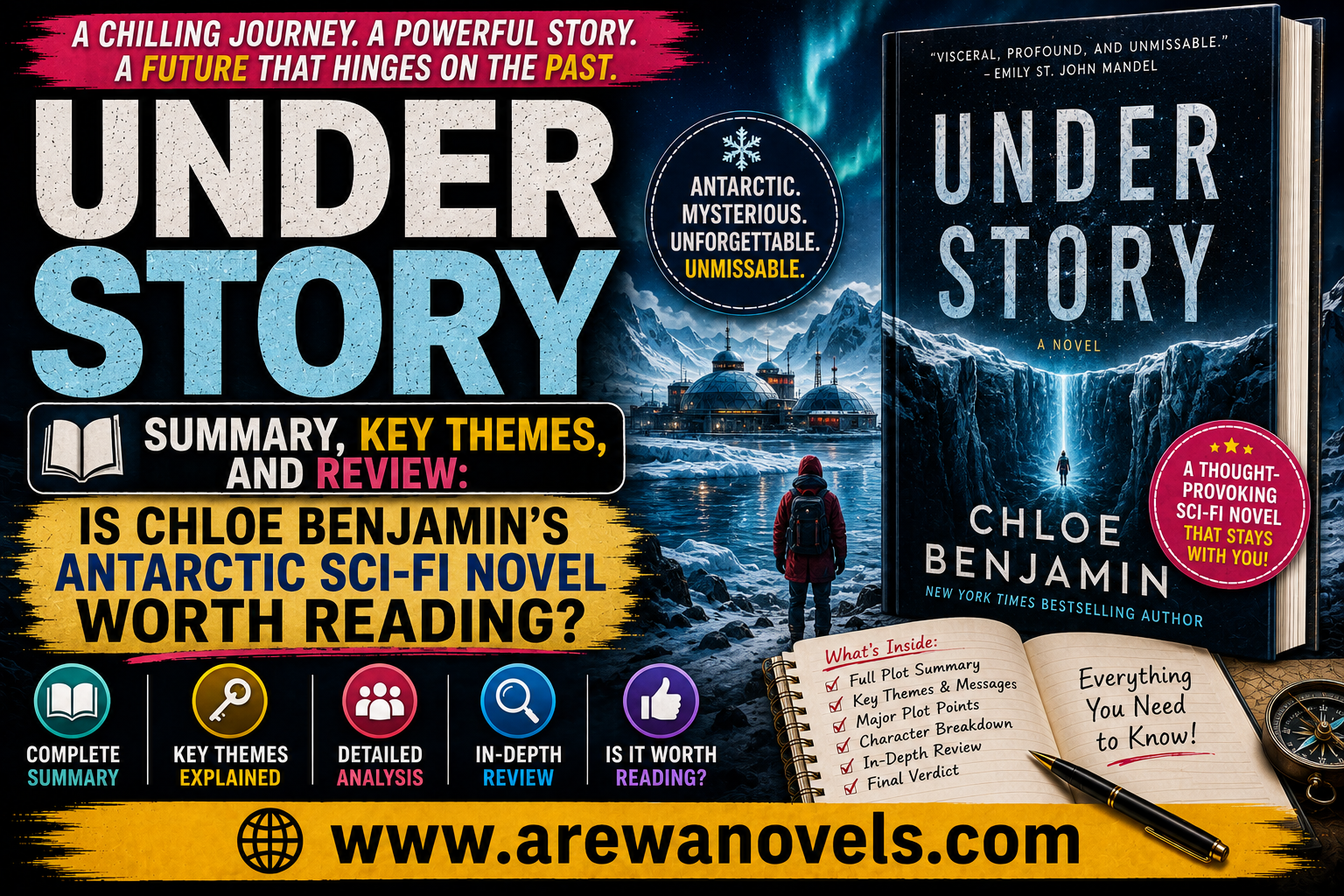
Chloe Benjamin, best known for The Immortalists, sends her third novel about as far from a fortune teller's storefront as a story can get: to a dishwashing station at the bottom of the world. Under Story follows a grieving, divorced biologist who takes a job at McMurdo Station in Antarctica to escape her old life, only to find that her old life, in the shape of a glowing anomaly and her physicist ex-husband, has followed her there. What starts as a quiet story about starting over becomes a genre-bending meditation on grief, time, and how far two people will go to undo a tragedy.
This guide covers the full Under Story plot, breaks down the novel's central science-fiction concept, the duoverse, and closes with themes, lessons, and discussion questions for anyone reading it for a book club or class, including this month's GMA Book Club pick discussion.
Book Overview
Title: Under Story Author: Chloe Benjamin Genre: Literary fiction, speculative fiction, science fiction romance Publisher: Putnam, an imprint of Penguin Random House Published: September 2026 Setting: McMurdo Station, an American research base in Antarctica, and a mysterious parallel realm called the duoverse Central conflict: Laurel and her ex-husband Eli's attempt to use a strange anomaly on the ice to travel into a parallel universe and undo the death of their son Main idea: Grief does not resolve simply by reversing time, and love, even love that has been broken by tragedy, requires facing loss directly rather than trying to escape or undo it
Benjamin is the New York Times bestselling author of The Immortalists, named a best book of 2018 by NPR, The Washington Post, and Entertainment Weekly, and of The Anatomy of Dreams, winner of the Edna Ferber Fiction Book Award. Under Story was named among Lit Hub's Most Anticipated Books of 2026 well ahead of its release and was selected as Good Morning America's Book Club pick for September.
Under Story Summary
Laurel's Escape to Antarctica
Laurel Salter was once a promising young mycologist, a scientist who studies fungi, with a career full of potential and a family of her own. By the time the novel opens, both have fallen apart. She and her husband Eli, a physicist, have divorced following the death of their son, Silas, and Laurel has lost the sense of wonder that once defined her work, feeling that even nature's ordinary miracles have gone flat for her. When her mother mentions a childhood friend living in Antarctica, Laurel latches onto the idea on impulse and applies for a job as a dishwasher at McMurdo Station, the largest research base on the continent.
At McMurdo, Laurel joins a community of support staff known as "stewards," cooking and cleaning for the scientists stationed there, and slowly begins to rebuild a sense of connection with the people around her. The isolation and stark beauty of Antarctica offer her the escape she was looking for, distance from her grief, her failed marriage, and the career she walked away from.
The Arc
Laurel's fresh start is interrupted when a strange phenomenon appears on the ice: the Arc, a small, glowing dome of light, faintly pink and translucent, with no scientific explanation for its presence. It has no clear source and defies conventional physics, and its appearance quickly draws physicists from around the world to McMurdo Station, all trying to understand what it is and where it comes from.
Laurel recognizes the Arc immediately, not from any prior sighting, but from a drawing her ex-husband Eli once made of a concept he called the duoverse, a theory Eli developed to explain why certain quantum particles that should exist, according to physics, seem to be missing from our universe. Eli's theory holds that at the moment of the universe's creation, time and space formed in two directions at once, our own universe moving forward as we experience it, and a second, nearly identical universe existing in parallel, where time moves backward, from death toward birth.
Eli's Arrival
Not long after the Arc appears, Eli himself arrives at McMurdo, having been called in for his expertise as a physicist to help investigate the anomaly. His arrival forces Laurel and Eli back into direct contact for the first time since their divorce, and the reunion is anything but comfortable, since neither has fully processed the loss of their son or the end of their marriage.
As they study the Arc together, Laurel becomes convinced that it might be more than a scientific curiosity, that it could actually be a portal into the duoverse Eli once theorized, a world running in reverse. Eli is initially reluctant to test her theory, but the pull of what such a portal could mean, the possibility of reaching a version of reality where their son might still be reachable, proves difficult for either of them to resist.
Into the Duoverse
Eventually, using a combination of speculative physics and dreams that seem to guide them, Laurel and Eli find their way through the Arc and into the duoverse itself, a world where time runs in the opposite direction from their own: people age backward from death toward birth, seasons and historical events unfold in reverse order, and the ordinary rules governing biology and physics operate on an inverted logic that takes real effort for Laurel and Eli to adjust to and survive within.
Their goal in entering the duoverse is to reach their son Silas, or a version of the tragedy that took him from them, in the hope that reversing time might let them undo what happened, or at least offer them a chance to say goodbye and find peace they were never able to reach in their own world. The novel follows their disorienting journey through this backward-running realm, weaving in memories of their life together, their courtship in high school, their marriage, and the events surrounding Silas's death, alongside the strange, mirrored logic of the world they now find themselves navigating.
The Ending
Laurel and Eli's time in the duoverse forces them to confront both the tragedy that separated them and the deeper truth that reversing time cannot simply erase grief or restore what was lost. Their journey becomes as much about facing their own despair and their enduring love for each other as it does about the mechanics of the world they are moving through. By the novel's end, the two must find a way back to their own world, carrying with them whatever resolution, or lack of resolution, their journey through the duoverse has given them regarding Silas's death and their broken marriage. Reviewers describe the ending as emotionally satisfying and complete, closing the story of Laurel and Eli's relationship with a sense of arrival rather than leaving it unresolved, even as some readers found the mechanics of the duoverse itself more disorienting than the emotional core of the book.
Key Concepts Explained
The duoverse is Eli's theoretical framework, later revealed to be real, describing a second universe formed alongside our own at the moment of the Big Bang, in which time runs in reverse, from death to birth, explaining the existence of quantum particles that seem to be missing from conventional physics in our own universe.
The Arc is the physical manifestation of the boundary between the two universes, appearing at McMurdo Station as a small, glowing, pink-tinged dome that draws scientific attention long before Laurel and Eli come to understand, and eventually use, its true nature as a portal.
The stewards are the support staff at McMurdo Station, including cooks and dishwashers like Laurel, whose community offers her the human connection and sense of purpose she has lost by the time she arrives in Antarctica.
Major Themes
Grief and the impossibility of undoing loss
The novel's central emotional engine is Laurel and Eli's shared grief over their son Silas, and their journey into the duoverse dramatizes, quite literally, the fantasy of reversing time to undo a tragedy. Benjamin uses the mechanics of the duoverse to explore whether such a reversal could ever actually provide the resolution grieving people long for, or whether grief requires a different kind of reckoning entirely.
Love that survives, and is tested by, tragedy
Laurel and Eli's relationship, formed in high school and tested by the loss of their son, sits at the emotional core of the novel. Their journey through the duoverse becomes as much a test of whether their love can survive direct confrontation with their shared pain as it is a scientific expedition.
Nature, science, and wonder
Laurel's background as a mycologist and the novel's careful attention to the ecosystems and fieldwork of Antarctic research reflect Benjamin's broader interest in the natural world, and reviewers have specifically praised the novel's well-integrated depictions of flora, fauna, and environmental fragility as more than backdrop to the human story.
Time, aging, and the direction of a life
The duoverse's reversed timeline gives Benjamin a vehicle to explore aging, memory, and the direction of a human life from an unusual angle, asking what it might mean to experience a life's events in the opposite order, and what that reversal reveals about how people usually understand growth, loss, and meaning.
Major Conflicts
The central conflict is emotional rather than purely physical: Laurel and Eli's unresolved grief over Silas's death and the failure of their marriage in its aftermath, which the journey into the duoverse forces them to confront directly rather than continue avoiding.
A secondary conflict runs through the practical challenge of surviving and understanding the duoverse itself, a world whose reversed physical and biological rules put Laurel and Eli's scientific expertise, and their trust in each other, under real pressure.
Setting
The novel is anchored at McMurdo Station, an isolated American research base in Antarctica, rendered by reviewers as vividly authentic, down to the details of stewards' daily routines and the fieldwork of the scientists stationed there. The duoverse itself, reached through the Arc, provides a second, stranger setting defined by reversed time, where the ordinary logic of aging, seasons, and even historical events plays out backward, giving Benjamin a fully realized alternate world to set against the grounded realism of the Antarctic research station.
Important Symbols
The Arc symbolizes both scientific mystery and emotional possibility, a glowing anomaly that draws physicists purely as a phenomenon to study, while quietly representing, for Laurel, a chance to reach the parts of her life she has lost.
The duoverse's reversed time symbolizes the fantasy of undoing grief, literalizing the wish so many grieving people carry, to turn back the clock and change what happened, while the novel ultimately uses that same reversal to explore why such an undoing cannot fully heal what has been lost.
Important Lessons From the Book
Grief cannot be solved through avoidance or escape, even a escape as extreme as fleeing to the most remote research station on Earth, since Laurel's attempt to outrun her old life at McMurdo is what ultimately brings her face to face with it again.
Reversing time, even if it were literally possible, would not simply undo loss, since Laurel and Eli's journey through the duoverse forces them to reckon with their grief directly rather than finding a shortcut around it.
Love that has been damaged by tragedy can still be worth returning to, but only through honest confrontation with what caused the damage in the first place, not through a fantasy of erasing it.
Wonder and connection can be rebuilt even after a person feels they have lost access to both, as shown in Laurel's slow reawakening among the stewards at McMurdo before Eli or the Arc ever enter the story.
Character Relationships
Laurel and Eli's relationship anchors the entire novel, moving between their high school courtship, their marriage, the loss of their son, their divorce, and their reunion at McMurdo, giving readers a full, nonlinear picture of a partnership shaped as much by shared brilliance as by shared devastation.
Laurel and the stewards at McMurdo represent a different, quieter kind of relationship, one built on ordinary daily labor and companionship rather than romance or tragedy, and this community is part of what allows Laurel to begin healing even before Eli's arrival complicates her fresh start.
Most Important Events to Remember
Laurel's decision to leave her old life and take a job as a dishwasher at McMurdo Station, following her divorce from Eli and the death of their son Silas.
The appearance of the Arc, the glowing anomaly that draws physicists to the research base.
Eli's unexpected arrival at McMurdo to help study the anomaly, forcing him and Laurel back into direct contact.
Laurel's recognition of the Arc as a possible manifestation of Eli's theoretical duoverse.
Laurel and Eli's journey through the Arc into the duoverse itself, a reversed-time realm, in an attempt to reach their son or undo the tragedy that separated them.
Their eventual return from the duoverse, carrying whatever resolution their journey has given them regarding their grief and their relationship.
Book Analysis
Under Story works by taking a very literal, science-fiction premise, a parallel universe where time runs backward, and using it as a sustained metaphor for one of grief's most persistent fantasies: the wish to turn back the clock and undo a loss. Reviewers have consistently praised how thoroughly Benjamin commits to the mechanics of the duoverse, exploring what a reversed timeline would actually mean for aging, memory, and the natural world, rather than treating the concept as a loose gimmick.
At the same time, some critics have found the extended stay in the duoverse to strain under the weight of its own internal logic, noting that maintaining a genuinely reversed world across a long novel requires the author to make selective choices about which biological processes run backward and which do not, choices that can start to feel more convenient than consistent the longer the journey continues. Whether a reader finds this immersive or overly complicated may depend on how much patience they have for speculative world-building layered on top of a grief narrative.
What is not in dispute across reviews is the emotional core of the book: Laurel and Eli's relationship, tested by tragedy and then tested again by an impossible journey meant to undo that tragedy, gives the novel's speculative premise real stakes. Publishers Weekly specifically credited the novel's heart to this relationship rather than to its science-fiction mechanics, suggesting that whatever readers make of the duoverse's internal rules, the emotional throughline of two grieving parents finding their way back to each other is what the book is ultimately built around.
Study Guide
Key Facts to Remember
Author: Chloe Benjamin. Published: September 2026, Putnam. Genre: literary fiction, speculative fiction, science fiction romance. Setting: McMurdo Station, Antarctica, and the duoverse.
Important Characters to Remember
Laurel Salter, a mycologist who takes a job as a dishwasher at McMurdo Station following her divorce and the death of her son. Eli, Laurel's ex-husband and a physicist whose theory of the duoverse turns out to be real. Silas, Laurel and Eli's son, whose death is the central tragedy driving the novel.
Important Themes to Remember
Grief and the impossibility of undoing loss. Love tested and possibly restored by shared tragedy. Nature, science, and wonder. Time, aging, and the direction of a life.
Important Events to Remember
Laurel's move to McMurdo Station. The appearance of the Arc. Eli's arrival at the research base. The discovery that the Arc may be a portal to the duoverse. Laurel and Eli's journey into the reversed-time realm. Their eventual return and the resolution of their grief and relationship.
Frequently Asked Questions
What is Under Story about? It follows Laurel Salter, a grieving biologist who takes a dishwashing job at an Antarctic research station to escape her old life, only to be drawn, alongside her physicist ex-husband Eli, into a mysterious parallel universe where time runs backward, in an attempt to reach their deceased son and heal their broken marriage.
What is the duoverse in Under Story? It is a theoretical, and ultimately real, second universe formed alongside our own at the moment of the Big Bang, in which time moves in reverse, from death toward birth, first proposed by Eli as a way to explain missing quantum particles in conventional physics.
Who are the main characters? Laurel Salter, a mycologist rebuilding her life at McMurdo Station, and her ex-husband Eli, a physicist whose scientific theory turns out to describe a real, reachable world.
What is the Arc? A small, glowing, pink-tinged dome of light that appears near McMurdo Station with no scientific explanation, eventually revealed to be a portal into the duoverse.
What happens at the end of Under Story? Laurel and Eli's journey through the duoverse forces them to directly confront the grief and damage caused by their son Silas's death, and while reviewers describe the ending as emotionally resolved for their relationship, the novel makes clear that reversing time cannot simply erase what was lost, only offer a different kind of reckoning with it.
Is Under Story worth reading? Reviews are largely positive, with Publishers Weekly and Kirkus praising its emotional depth and imaginative premise, though some critics have found the extended sequences inside the duoverse's reversed logic more contrived than the grounded, grief-focused core of the story, so readers who prefer speculative fiction with airtight internal rules may find some frustration alongside the emotional payoff.
What are the major themes of Under Story? Grief and the impossibility of undoing loss, love tested and potentially restored by shared tragedy, the wonder of the natural world, and the meaning of time and aging when experienced in reverse.
Discussion and Review Questions
Short-answer: Why does Laurel take a job as a dishwasher at McMurdo Station, and what is she actually hoping to escape? Answer guidance: connect her decision to the death of her son Silas and her divorce from Eli, and her loss of wonder in her own scientific work.
Concept question: Explain Eli's theory of the duoverse and how the Arc relates to it. Answer guidance: describe the reversed-time second universe theorized to explain missing quantum particles, and the Arc as its physical, discoverable manifestation at McMurdo.
Character question: How does Laurel and Eli's relationship change over the course of the novel, from their reunion at McMurdo through their journey into the duoverse? Answer guidance: trace their initial discomfort, their shared scientific curiosity about the Arc, and the deeper emotional reckoning forced by their time in the reversed-time world.
Theme question: Does the novel ultimately argue that reversing time can heal grief, or that it cannot? Support your answer with evidence from Laurel and Eli's journey. Answer guidance: discuss how their time in the duoverse forces direct confrontation with their loss rather than providing a simple undoing of it, and evaluate what the ending suggests about the limits of that fantasy.
Analysis question: How does Benjamin use the setting of Antarctica, apart from the duoverse itself, to support the novel's themes of isolation and renewal? Answer guidance: reference Laurel's community with the stewards and the stark, remote beauty of McMurdo Station as a space for rebuilding connection before the Arc complicates her fresh start.
Essay question: Discuss how Under Story uses a science-fiction premise, a parallel universe with reversed time, as a metaphor for grief. Answer guidance: build an argument connecting the mechanics of the duoverse to the emotional experience of wanting to undo a loss, using specific details from Laurel and Eli's journey.
Essay question: Critics have been divided on whether the extended sequences in the duoverse strengthen or weaken the novel. Evaluate this critique using specific examples from the book's handling of reversed biological and physical rules. Answer guidance: weigh the emotional payoff of Laurel and Eli's journey against the internal consistency challenges some reviewers identified in the duoverse's rules.
Quick Revision Sheet
Book: Under Story Author: Chloe Benjamin Genre: Literary fiction, speculative fiction, science fiction romance Published: September 2026, Putnam Setting: McMurdo Station, Antarctica, and the duoverse Main characters: Laurel Salter and her ex-husband Eli Main conflict: Laurel and Eli's attempt to use a mysterious portal to reach their deceased son and heal their broken marriage Major themes: Grief and the impossibility of undoing loss, love tested by tragedy, nature and wonder, time and the direction of a life Key events: Laurel's move to McMurdo, the appearance of the Arc, Eli's arrival, the discovery of the duoverse, their journey through reversed time, their return and emotional resolution Central message: Reversing time cannot erase grief, but confronting it directly can restore what mattered most Major lesson: Escaping grief only postpones it, while facing it, however painful, opens the possibility of healing
Conclusion
Under Story takes an enormous creative swing, building a fully realized parallel universe running backward through time, and uses it in service of a very human story about grief, marriage, and the impossible wish to undo a tragedy. Whether every reader finds the mechanics of the duoverse fully convincing, the emotional core of Laurel and Eli's journey back to each other, and to a reckoning with what they lost, is what critics and early readers agree gives the novel its lasting weight.
Understanding Laurel's arc from McMurdo dishwasher to duoverse traveler, Eli's theory and its real-world confirmation, and the novel's central argument about grief and time gives you everything you need to discuss this book with confidence, whether for a book club, a class, or your own reading notes.
For more literary fiction and speculative fiction guides, you can explore the full library at ArewaNovels.
Sources consulted: BookPage: Under Story review and Good Morning America: Under Story Book Club pick