
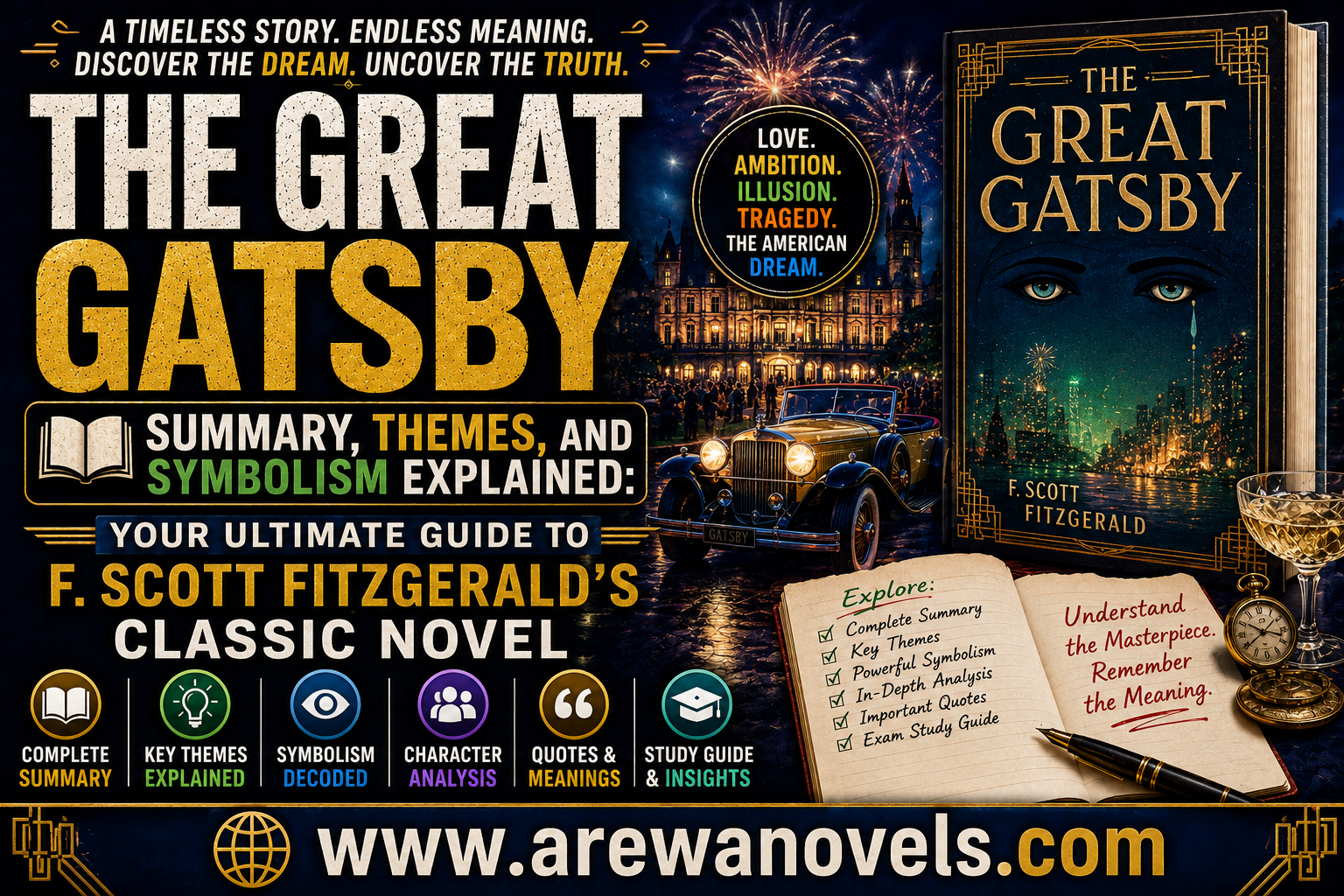
F. Scott Fitzgerald is on of the greatest author I personally respect so much, the author behind "The Great Gatsby" published in 1925 to modest sales and mixed reviews, and it has since become the novel most Americans think of when they picture the Jazz Age: champagne towers, roaring parties, a mysterious millionaire, and a green light blinking across the water. Underneath the glamour, Fitzgerald is telling a much colder story about a country that has confused wealth with worth and a man who mistook a woman for the entire meaning of his life.
This guide covers the full Great Gatsby summary, breaks down every major character and symbol, and explains the ending in detail, so consider this your spoiler warning if you have not finished the novel yet.
Reading guide
- Book Overview
- The Great Gatsby Plot Summary
- Main Characters
- Major Themes
- Symbolism Explained
- Literary Devices
- Important Lessons From the Book
- The Ending Explained
- Study Guide
- Frequently Asked Questions
- Exam and Test Questions
- Quick Revision Sheet
Book Overview
Title: The Great Gatsby Author: F. Scott Fitzgerald Genre: Tragedy, literary fiction, social satire First published: 1925 Setting: Long Island and New York City in the summer of 1922 Narrator: Nick Carraway, a young Yale graduate and bond salesman who becomes Gatsby's neighbor Central conflict: Jay Gatsby's obsessive pursuit of Daisy Buchanan, the woman he loved and lost years earlier, now trapped in an unhappy marriage to the wealthy, careless Tom Buchanan Main idea: The American Dream, the belief that anyone can remake themselves and earn happiness through wealth and ambition, collapses when it collides with a class system that was never actually open to outsiders, no matter how much money they accumulate
The Great Gatsby Plot Summary
Nick Carraway moves to West Egg, Long Island, in the summer of 1922 to work in the bond business, renting a small house next door to a vast, brightly lit mansion belonging to a man named Jay Gatsby, who no one seems to actually know despite throwing lavish, crowded parties every weekend. Nick's cousin Daisy Buchanan lives across the bay in the more fashionable East Egg with her wealthy, brutish husband Tom, and Nick soon learns that Tom is openly having an affair with a woman named Myrtle Wilson, who is married to a struggling garage owner named George Wilson.
Nick is eventually invited to one of Gatsby's parties and finally meets his elusive neighbor, discovering that Gatsby is charming, oddly formal, and the subject of constant rumor and speculation among his own guests, few of whom know anything true about him. Through Gatsby's friend Jordan Baker, a professional golfer Nick begins seeing romantically, Nick learns the real reason Gatsby moved to West Egg: he was once involved with Daisy years earlier, before he went to war and before she married Tom, and he has spent the years since amassing his fortune specifically to win her back, buying a house directly across the water from her home so the green light at the end of her dock is visible from his lawn.
Gatsby asks Nick to arrange a reunion with Daisy, and the two rekindle their connection, beginning an affair that Gatsby is convinced will lead to Daisy leaving Tom entirely. Tom, suspicious of Daisy's behavior and increasingly threatened by Gatsby, investigates his background and discovers that Gatsby's fortune comes from bootlegging and other criminal enterprises, undermining the polished, invented persona Gatsby has built for himself.
The tension comes to a head during a confrontation at the Plaza Hotel in New York, where Tom exposes Gatsby's criminal dealings and forces Daisy to choose between the two men. Daisy, shaken, cannot bring herself to say she never loved Tom, and the moment reveals that her attachment to her marriage, and to the security and social status it represents, runs deeper than her feelings for Gatsby.
Main Characters
Jay Gatsby
Born James Gatz to a poor farming family, Gatsby reinvents himself entirely, adopting a new name and a carefully constructed persona of old wealth and refinement, all in pursuit of Daisy, the woman he fell in love with as a young officer before he had the money or status to keep her. His entire fortune, his mansion, and his relentless parties exist for one purpose: to recreate the past and win Daisy back, a goal the novel treats as both deeply romantic and fundamentally delusional, since Gatsby refuses to accept that the years since their first romance cannot simply be erased.
Nick Carraway
Nick narrates the novel from a position of claimed honesty and moral clarity, describing himself early on as inclined to reserve judgment, though the story he tells reveals him growing increasingly disillusioned with the wealthy world he has entered. His friendship with Gatsby, and his front-row seat to the Buchanans' carelessness, shapes him into the novel's moral center, someone who ultimately rejects the glittering, corrupt world he has witnessed.
Daisy Buchanan
Daisy is beautiful, charming, and defined throughout the novel by a voice Gatsby's friend Jordan describes as full of money, an observation that captures how thoroughly Daisy's appeal is tied to the wealth and security she represents rather than to any independent depth of character the novel grants her. Her choice to stay with Tom, despite everything, reflects both her own fear of instability and the novel's broader argument that old money protects its own, regardless of personal unhappiness or moral failing.
Tom Buchanan
Tom is wealthy, physically imposing, and openly unfaithful, a man whose old-money arrogance and casual racism establish him early as the novel's most direct representation of entrenched privilege. His investigation into Gatsby's criminal past, and his manipulation of the truth in the novel's final confrontation, show a man willing to use his social power ruthlessly to protect what he considers his.
Jordan Baker
Jordan is a professional golfer and Daisy's friend, cynical and detached, whose dishonesty on the golf course, revealed early in the novel, quietly signals the moral carelessness running through the entire wealthy social circle Nick has entered. Her brief romance with Nick ends as the novel's illusions collapse, mirroring his broader disillusionment with the world she belongs to.
Myrtle and George Wilson
Myrtle, Tom's mistress, is desperate to escape her marriage to George, a struggling garage owner, and to enter the wealthier world Tom represents, a desire that ultimately costs her life. George, grieving and manipulated by Tom in the novel's final chapters, becomes the instrument of the novel's most violent consequence, believing wrongly that Gatsby was both his wife's lover and her killer.
Major Themes
The corruption of the American Dream
Gatsby's rise from poverty to enormous wealth initially looks like the American Dream fulfilled, but Fitzgerald reveals that his fortune is built on crime, and that no amount of money can actually buy him entry into Daisy's old-money world. The novel argues that the dream of self-made reinvention is fundamentally undermined by a class system that judges the source and history of wealth, not merely its size.
Class and the divide between old and new money
West Egg, where Gatsby lives, represents new, often recently and disreputably earned wealth, while East Egg, home to Tom and Daisy, represents old, inherited money and the social legitimacy that comes with it. The novel consistently shows East Egg's residents treating West Egg's wealthy newcomers with condescension, regardless of how much money separates them in practice.
The destructive power of the past
Gatsby's entire project rests on the belief that the past can be recreated and reclaimed, a belief Nick directly challenges near the novel's end. Fitzgerald frames this refusal to accept the passage of time as both the source of Gatsby's romantic intensity and the central flaw that dooms him.
Carelessness and the privilege of consequence-free wealth
Tom and Daisy are explicitly described by Nick as careless people who smash things and retreat into their money, letting others clean up the damage they cause. This carelessness, more than any single act of villainy, is presented as the novel's real moral indictment of the wealthy class it depicts.
Illusion versus reality
Gatsby's entire identity, his name, his backstory, his claimed education, is a carefully maintained illusion, and the novel is populated by characters who see only surfaces: Gatsby's party guests gossip about him without knowing him, and Daisy falls for a version of Gatsby built more on wealth and spectacle than on genuine reacquaintance.
Symbolism Explained
What does the green light mean in The Great Gatsby?
The green light at the end of Daisy's dock, visible from Gatsby's lawn, symbolizes Gatsby's longing for Daisy and, more broadly, the unreachable nature of the American Dream itself. Early in the novel, Nick sees Gatsby reaching toward it across the water, a gesture of yearning for something that always remains just out of grasp. In the novel's final, famous passage, Nick expands the symbol outward, comparing Gatsby's reach for the green light to humanity's broader pursuit of an ever-receding future, tying Gatsby's personal tragedy to a much larger statement about hope, ambition, and the impossibility of ever fully arriving at what we long for.
The Valley of Ashes
The Valley of Ashes, a desolate, industrial wasteland between West Egg and New York City, symbolizes the human and environmental cost of the wealthy characters' pursuit of pleasure and status, a decaying landscape that the novel's rich characters pass through without ever truly seeing or acknowledging.
The eyes of Doctor T. J. Eckleburg
A faded billboard advertisement featuring a pair of enormous bespectacled eyes looms over the Valley of Ashes, and several characters, particularly George Wilson, come to interpret the image as representing the eyes of God, watching over a morally bankrupt world with judgment but without intervention.
Gatsby's mansion and parties
Gatsby's enormous house and lavish, chaotic parties symbolize the emptiness beneath his constructed persona, a spectacle designed entirely to attract Daisy's attention, populated by guests who take advantage of his hospitality without any genuine loyalty or connection to him.
The color white and Daisy's characterization
Daisy is repeatedly associated with the color white, evoking purity and innocence on the surface, while the novel steadily reveals this association to be a kind of illusion, since Daisy's actions, her affair, her choice to stay with Tom, and her silence after the novel's central tragedy, are far from innocent.
Literary Devices
Symbolism runs throughout the novel, from the green light to the Valley of Ashes to Eckleburg's eyes, giving Fitzgerald a way to layer meaning onto Long Island's literal geography.
First-person retrospective narration, filtered through Nick Carraway, shapes the entire novel's tone, since Nick is both a participant in the events and a narrator looking back with the benefit of hindsight and disillusionment.
Foreshadowing appears early and often, particularly in Nick's initial description of Gatsby's extraordinary gift for hope, which sets up both the romantic intensity and the eventual tragedy of Gatsby's pursuit of Daisy.
Irony shapes much of the novel's social commentary, particularly in the gap between the glittering surface of Gatsby's world and the moral emptiness Nick gradually uncovers beneath it.
Important Lessons From the Book
Wealth alone cannot purchase social acceptance or rewrite a person's origins, no matter how completely a person tries to reinvent themselves, as Gatsby's failure to fully enter Daisy's world demonstrates.
Living entirely in service of an idealized past is a dangerous foundation for a life, since Gatsby's refusal to accept that time has changed both himself and Daisy contributes directly to his downfall.
Privilege can insulate people from the consequences of their own carelessness, allowing them to cause real harm and then retreat into the protection their money and status provide.
Surfaces and reputations often obscure a much more complicated reality, and the novel repeatedly rewards readers, and punishes characters, who fail to look past a glamorous exterior.
The Great Gatsby Ending Explained
After the confrontation at the Plaza, Daisy drives Gatsby's car back to Long Island with Gatsby as her passenger, and on the way, she strikes and kills Myrtle Wilson, who runs into the road believing the car belongs to Tom. Gatsby, still devoted to Daisy even after her wavering loyalty at the Plaza, decides to take the blame for the accident, insisting to Nick that he was the one driving.
Tom, learning what happened, tells George Wilson, Myrtle's grieving husband, that Gatsby was driving the car that killed her, and further implies, falsely, that Gatsby was also Myrtle's lover. Consumed by grief and misled by Tom, George drives to Gatsby's mansion, shoots and kills him as he waits by his pool for a phone call from Daisy that never comes, and then turns the gun on himself.
In the novel's final chapters, Nick is left to arrange Gatsby's funeral almost entirely alone, since nearly none of the many guests who filled Gatsby's parties bother to attend, and Daisy and Tom quietly leave town without ever facing any real consequence for their roles in what happened, protected by their wealth and Nick's disgusted assessment that they simply retreat into their money and let other people clean up the mess they made. Nick, thoroughly disillusioned with the East Coast wealth and glamour that once drew him in, decides to return home to the Midwest.
The novel's final paragraph pulls back from Gatsby's individual story to a broader meditation on hope and the past, with Nick comparing Gatsby's yearning reach toward the green light to humanity's endless, doomed effort to move forward while constantly being pulled back into what has already happened, closing the novel on the famous line about being borne back ceaselessly into the past.
Study Guide
Key Facts to Remember
Author: F. Scott Fitzgerald. Published: 1925. Setting: West Egg, East Egg, and New York City, summer 1922. Narrator: Nick Carraway.
Important Characters to Remember
Jay Gatsby, the self-made millionaire obsessed with reclaiming Daisy. Nick Carraway, the narrator and Gatsby's neighbor. Daisy Buchanan, Gatsby's lost love, now married to Tom. Tom Buchanan, Daisy's wealthy, unfaithful husband. Jordan Baker, Daisy's cynical friend and Nick's love interest. Myrtle and George Wilson, Tom's mistress and her husband.
Important Themes to Remember
The corruption of the American Dream. The divide between old and new money. The destructive power of clinging to the past. The privilege of consequence-free wealth. The gap between illusion and reality.
Important Events to Remember
Nick's introduction to Gatsby and his parties. The reunion between Gatsby and Daisy. The confrontation at the Plaza Hotel. Myrtle's death. George's murder of Gatsby and subsequent suicide. Gatsby's poorly attended funeral and Nick's return to the Midwest.
Frequently Asked Questions
What is The Great Gatsby about? It follows Jay Gatsby, a self-made millionaire who throws lavish parties in hopes of winning back Daisy Buchanan, the woman he loved years earlier, now married to the wealthy, unfaithful Tom Buchanan, using their story to critique the American Dream and the rigid class divisions beneath its promise of reinvention.
What does the green light mean in The Great Gatsby? It symbolizes Gatsby's longing for Daisy and, more broadly, the unreachable nature of hope and the American Dream itself, an object Gatsby reaches toward across the water that the novel ultimately connects to humanity's endless pursuit of an ever-receding future.
What is the main message of The Great Gatsby? That the American Dream, as commonly understood, promising that wealth and reinvention can overcome any origin, collapses when it meets an entrenched class system that judges the history of money as much as its amount, and that unchecked privilege allows the wealthy to escape the consequences of real harm.
Who is the main character? Jay Gatsby is the title character and the novel's central figure, though the story is narrated by Nick Carraway, whose perspective shapes how readers understand Gatsby's rise, romance, and downfall.
What happens at the end? Daisy accidentally kills Myrtle while driving Gatsby's car, Gatsby takes the blame to protect her, and Tom manipulates the grieving George Wilson into believing Gatsby was both Myrtle's killer and her lover, leading George to murder Gatsby and then kill himself, while Daisy and Tom escape any real consequence.
What is the main conflict? Gatsby's obsessive pursuit of Daisy, and his belief that his wealth and reinvented identity can erase the years since their first romance and win her away from her marriage to Tom.
What lessons can readers learn? That wealth cannot buy genuine social acceptance or rewrite the past, that privilege often shields the wealthy from consequences others must bear, and that surfaces and reputations frequently obscure a far more complicated reality.
Why is the setting important? Because the geographic divide between old-money East Egg and new-money West Egg gives Fitzgerald a physical map for the novel's central argument about class, exposing how thoroughly social status depends on inherited wealth rather than simply its accumulation.
Exam and Test Questions
Short-answer: What does the green light symbolize, and how does its meaning expand in the novel's final paragraph? Answer guidance: connect Gatsby's personal longing for Daisy to Nick's closing reflection on humanity's broader, doomed pursuit of an ever-receding future.
Character question: How does Nick's assessment of Tom and Daisy as careless people function as the novel's central moral judgment? Answer guidance: reference their retreat into wealth after Myrtle's death and Gatsby's funeral, and connect this carelessness to the novel's critique of privilege.
Theme question: How does Fitzgerald use the divide between East Egg and West Egg to critique the American Dream? Answer guidance: discuss how Gatsby's immense wealth still fails to grant him full acceptance into Daisy's old-money world.
Plot question: Explain how Tom's manipulation of George Wilson leads directly to Gatsby's death. Answer guidance: trace Tom's false implication that Gatsby was Myrtle's lover and killer, and connect it to George's grief-driven decision to kill Gatsby.
Analysis question: Is Gatsby's devotion to Daisy admirable or self-destructive? Support your answer with evidence from the novel. Answer guidance: weigh the romantic intensity of his pursuit against his refusal to accept that the past cannot be recreated, and reach a supported conclusion.
Essay question: Discuss how Fitzgerald uses symbolism, including the green light, the Valley of Ashes, and Eckleburg's eyes, to develop the novel's themes. Answer guidance: connect each symbol to a specific thematic argument about hope, moral decay, or the absence of genuine oversight in a corrupt society.
Essay question: To what extent does The Great Gatsby argue that the American Dream is a fundamentally corrupted idea? Answer guidance: weigh Gatsby's self-made success and ultimate failure to win Daisy against the entrenched privilege of Tom and Daisy's old money, and reach a supported conclusion.
Quick Revision Sheet
Book: The Great Gatsby Author: F. Scott Fitzgerald Genre: Tragedy, literary fiction, social satire Published: 1925 Setting: West Egg, East Egg, and New York City, summer 1922 Narrator: Nick Carraway Main conflict: Gatsby's pursuit of Daisy, and his belief that wealth and reinvention can erase the past and overcome an entrenched class divide Major themes: The corruption of the American Dream, old versus new money, the destructive power of the past, careless privilege, illusion versus reality Important symbols: The green light, the Valley of Ashes, the eyes of Doctor T. J. Eckleburg, Gatsby's mansion and parties Key events: Gatsby and Daisy's reunion, the confrontation at the Plaza, Myrtle's death, Gatsby's murder, Nick's disillusioned return to the Midwest Central message: The American Dream cannot overcome an entrenched class system, and unchecked wealth allows the privileged to escape consequence Major lesson: Living entirely in service of an idealized past is a dangerous foundation for a life
Conclusion
The Great Gatsby endures because Fitzgerald builds a genuinely romantic story, a self-made man reaching across the water for the love he lost, and then systematically shows exactly why that romance cannot survive contact with the class system it was always up against. Gatsby's tragedy is not simply that he loses Daisy, it is that his entire understanding of what wealth could buy him was wrong from the start.
Understanding Gatsby's doomed pursuit, the symbolism of the green light and the Valley of Ashes, and Fitzgerald's critique of privilege and the American Dream gives you everything you need to discuss this novel with confidence, whether in a classroom, a book club, or an exam.
For more classic literature summaries and study guides, you can explore the full library at ArewaNovels.
Sources consulted: Britannica: The Great Gatsby