
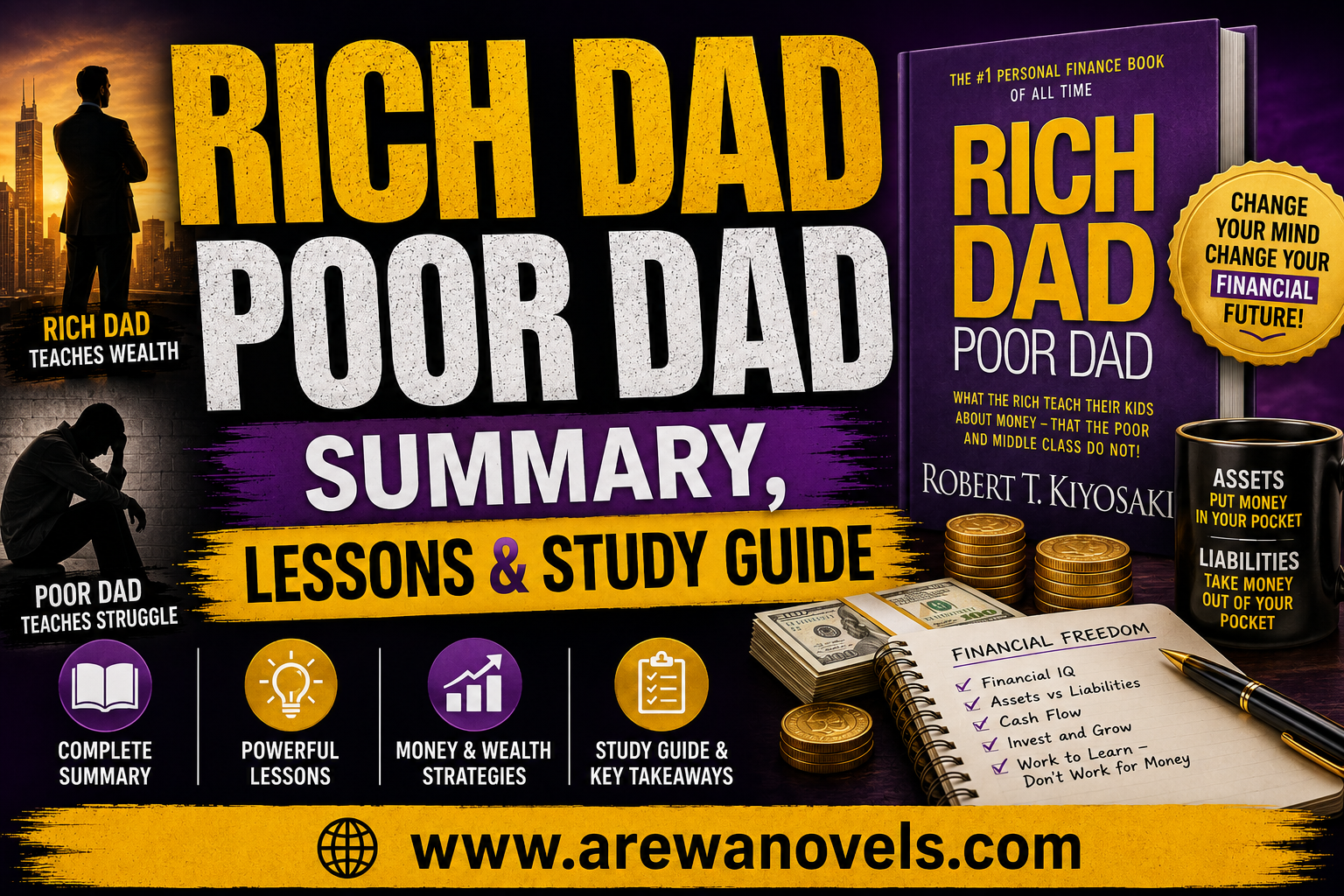
Robert Kiyosaki built Rich Dad Poor Dad around a simple trick: instead of lecturing readers about money, he tells a story about two father figures who taught him opposite lessons about it. One dad had the credentials and the steady paycheck. The other dad never finished eighth grade and became one of the richest men in Hawaii. The gap between their advice is the entire book.
This guide covers the full Rich Dad Poor Dad summary, breaks down the six core lessons in plain terms, and ends with a set of review questions you can use whether you are studying it for a book club, a finance class, or your own reading notes.
Book Overview
Title: Rich Dad Poor Dad Author: Robert T. Kiyosaki, with Sharon L. Lechter Genre: Personal finance, nonfiction, autobiography-influenced self-help First published: 1997 Structure: An introduction, six main lessons drawn from the author's two father figures, and a closing section on getting started Central idea: Financial independence comes from acquiring assets that generate income, not from earning a high salary, and the financial education most people never receive in school is the real barrier between them and wealth
Kiyosaki was born in Hawaii in 1947. The book frames itself as the story of growing up with two influential father figures: his own father, a well-educated school administrator he calls his "poor dad," and his best friend Mike's father, a businessman without much formal schooling he calls his "rich dad." The book has sold tens of millions of copies worldwide and is often credited as one of the most widely read personal finance books ever published, though its investment advice and some of its stories have also drawn criticism and skepticism from financial professionals over the years.
Rich Dad Poor Dad Summary
The book is built less like a traditional narrative and more like a set of extended lessons, each one illustrated with stories from Kiyosaki's childhood and early career. The frame holding it together is the comparison between his two dads.
His poor dad had a PhD, worked steadily in the education system, and believed firmly in the traditional path: study hard, get a secure job, earn a stable paycheck, and rely on a pension. Despite his education, he struggled financially for most of his life. His rich dad had dropped out of school young, built several businesses, and became genuinely wealthy, and he taught Kiyosaki and his own son Mike about money starting when the boys were nine years old, largely through real work and real-world lessons rather than lectures.
From that contrast, Kiyosaki draws six lessons that make up the core of the book.
Lesson One: The Rich Don't Work for Money
Kiyosaki's rich dad puts him and Mike to work for a token wage, then deliberately frustrates them with it, using the experience to make a point: working purely for a paycheck keeps a person trapped in what Kiyosaki calls the rat race, since most of that paycheck's purpose is simply covering bills that keep the same person needing to work again the next month. Rich dad argues that the goal is not to work harder for money but to make money and, eventually, assets work for you.
Lesson Two: Why Teach Financial Literacy
Kiyosaki argues that the most important distinction in personal finance is between an asset and a liability, defined in a specific, practical way: an asset puts money into your pocket, and a liability takes money out of it, regardless of what an accountant might otherwise call the item. By this definition, a home with a mortgage is a liability, not an asset, because of the ongoing costs it generates, a claim that became one of the book's most debated ideas.
He argues that financial literacy, understanding this distinction and applying it consistently, is not taught in most schools, which leaves even highly educated people vulnerable to poor financial decisions throughout their lives.
Lesson Three: Mind Your Own Business
Kiyosaki draws a distinction between a person's profession, the work they do to earn a paycheck, and their actual business, the assets they are building on the side. He encourages readers to keep their day job if needed for income, while consistently directing money toward building an asset column: real estate, stocks, intellectual property, or businesses that generate income independent of hours worked.
Lesson Four: The History of Taxes and the Power of Corporations
Kiyosaki explains how tax law tends to reward business owners and investors more than employees, since corporations can often use income to cover certain expenses before taxes are calculated, while employees typically pay taxes first and spend what remains afterward. He argues that understanding this legal and financial structure, not necessarily evading taxes, is one of the ways the wealthy legally keep more of what they earn.
Lesson Five: The Rich Invent Money
Kiyosaki argues that financial opportunity is less about formal education and more about financial intelligence: the ability to recognize opportunities, manage risk, and act on a deal that others might overlook or feel too anxious to pursue. He illustrates this with stories of finding undervalued opportunities, arguing that people with strong financial intelligence effectively create wealth-building chances for themselves rather than waiting for a stable path to be handed to them.
Lesson Six: Work to Learn, Don't Work for Money
Kiyosaki advises readers, particularly early in their careers, to choose jobs and experiences based on what skills they will gain rather than purely on salary. He argues that broad skills, sales, communication, negotiation, basic accounting, are worth more over a lifetime than a slightly higher starting salary in a narrow role, since those skills compound across whatever ventures a person eventually builds.
Overcoming Obstacles and Getting Started
In the book's closing chapters, Kiyosaki addresses common psychological barriers to building wealth, including fear of loss, cynicism, laziness, bad habits, and overconfidence. He closes with a practical set of steps for readers to begin applying the book's ideas, encouraging small, consistent action rather than waiting for a large sum of money or a perfect plan before starting.
Key Concepts Explained
Assets versus liabilities, defined by cash flow rather than by conventional accounting, is the single idea the rest of the book is built around: an asset generates income, a liability generates expenses, and building wealth means consistently acquiring the first category while minimizing the second.
The rat race describes the cycle Kiyosaki says traps most employees: earn a paycheck, spend it covering expenses and debt, and repeat the cycle indefinitely without ever building assets that could eventually replace the need to work for income at all.
The cash flow quadrant, though developed more fully in Kiyosaki's later books, is introduced here in early form, dividing people into employees and self-employed people, who trade time for money, and business owners and investors, who Kiyosaki argues have the most realistic path to lasting financial independence.
Financial literacy is Kiyosaki's term for the practical, often self-taught knowledge of how money, assets, taxes, and risk actually work, which he argues matters more for building wealth than academic credentials or a high salary alone.
Major Themes
Financial education is not the same as academic education
Kiyosaki's central argument is that schools train people to be good employees but rarely teach them how money itself works, leaving even highly credentialed people financially vulnerable. The book positions itself as filling that specific gap.
Assets, not income, build lasting wealth
Kiyosaki repeatedly returns to the idea that a high salary alone does not create financial independence if it is not converted into income-generating assets, using his poor dad's steady but ultimately limited financial position as the clearest example.
Mindset and financial intelligence matter as much as opportunity
Kiyosaki frames wealth-building as much a psychological skill as a technical one, arguing that fear, cynicism, and habit keep people from acting on opportunities that financial intelligence alone would recognize as worthwhile.
Ownership versus employment
The book consistently favors ownership, of a business, of real estate, of income-generating assets, over employment, arguing that owners have more control over their financial outcomes and more favorable tax treatment than employees typically do.
Major Lessons From the Book
Understand the real difference between an asset and a liability, and apply that definition honestly even when it contradicts common assumptions, such as treating a primary home purely as an investment.
Direct income toward building an asset column consistently, rather than only increasing spending as income rises, which Kiyosaki argues is the habit that separates people who build wealth from people who simply earn a good living.
Treat financial literacy as a skill to actively develop, since Kiyosaki argues it is rarely taught directly and must usually be sought out deliberately, through reading, mentorship, or direct experience.
Choose early career experiences for the skills they build, not just the salary they offer, since broad, transferable skills compound in value over a working lifetime.
Address the psychological barriers to financial risk directly. Kiyosaki argues that fear of loss and habitual caution, more than lack of opportunity, are what keep many people from ever building assets in the first place.
Important Concepts or Passages
Kiyosaki's repeated line that an asset puts money in your pocket while a liability takes money out functions as the book's thesis statement, and nearly every later lesson builds on this single distinction.
His description of most people being trapped in the rat race, earning money only to spend it on the expenses that require earning more money, gives readers a memorable image for the cycle he argues financial literacy is meant to break.
The framing of his two dads as parallel case studies, one highly credentialed but financially strained, one under-credentialed but financially independent, is the book's central rhetorical device, and it is what most readers remember even years after reading it.
Most Important Ideas to Remember
The distinction between assets and liabilities, defined by cash flow rather than conventional accounting.
The rat race, and the argument that a paycheck alone rarely leads to financial independence.
The value of financial literacy as a skill schools generally do not teach.
The distinction between a profession and a business, and the advice to build an asset column alongside a day job.
The tax and legal advantages Kiyosaki attributes to business owners and investors compared to employees.
The idea of working early in a career primarily to learn transferable skills, not just to earn a salary.
The psychological barriers, fear, cynicism, laziness, bad habits, overconfidence, that Kiyosaki argues keep many people from acting on financial opportunity.
Book Analysis
Rich Dad Poor Dad's lasting influence comes less from any specific investment strategy and more from the mental reframe it offers: measuring financial decisions by whether they put money into your pocket or take money out, rather than by conventional labels like "investment" or "savings." That single lens is simple enough to apply immediately, which is likely why the book has remained widely read for decades despite significant criticism of some of its specific claims and stories.
The book has also drawn real scrutiny. Financial professionals and journalists have pointed out that several anecdotes in the book, including some details about Kiyosaki's rich dad, have never been independently verified, and some of the book's specific investment and tax claims oversimplify rules that vary significantly by country, situation, and time period. Readers studying the book seriously should treat it as a mindset primer rather than a precise technical manual, useful for reframing how to think about money, less reliable as a source of specific, up-to-date financial or tax advice.
What the book gets right, according to many readers and reviewers, is naming a real gap: most school systems do not teach practical financial literacy, and many people reach adulthood without a clear framework for thinking about assets, liabilities, and cash flow. Whatever the book's flaws in detail, that gap, and the appetite for a simple framework to address it, explains much of its enduring popularity.
Study Guide
Key Facts to Remember
Author: Robert T. Kiyosaki, with Sharon L. Lechter. Published: 1997. Genre: personal finance, nonfiction. Structure: introduction, six core lessons, and a closing section on getting started. Central framework: the distinction between assets and liabilities based on cash flow.
Key Concepts to Remember
Assets versus liabilities. The rat race. The cash flow quadrant in early form. Financial literacy as a learnable, practical skill. The distinction between working for money and having assets work for you.
Important Themes to Remember
Financial education differs from academic education. Assets, not income alone, build lasting wealth. Mindset and financial intelligence matter alongside opportunity. Ownership is favored over employment as a path to financial independence.
Important Lessons to Remember
Learn to distinguish assets from liabilities honestly. Build an asset column consistently rather than only increasing spending. Treat financial literacy as a skill to actively pursue. Choose early career moves for the skills they build. Address fear and habitual caution directly as barriers to financial risk.
Frequently Asked Questions
What is Rich Dad Poor Dad about? It is a personal finance book that contrasts the financial lessons of the author's own father, who was highly educated but financially strained, with those of his best friend's father, who built substantial wealth without much formal schooling, using that contrast to argue for a specific, practical kind of financial literacy.
What is the main message of Rich Dad Poor Dad? That building lasting wealth depends on acquiring income-generating assets and understanding basic financial literacy, not simply on earning a high salary or having strong academic credentials.
What is the difference between an asset and a liability in the book? Kiyosaki defines an asset as anything that puts money into your pocket and a liability as anything that takes money out, a definition based on cash flow rather than conventional accounting categories.
What are the six lessons in Rich Dad Poor Dad? The rich don't work for money, the importance of financial literacy, minding your own business by building an asset column, understanding taxes and corporations, the idea that the rich invent money through financial intelligence, and working to learn rather than only working for a paycheck.
Is Rich Dad Poor Dad based on a true story? Kiyosaki presents it as based on his own life and his two father figures, though several details and anecdotes in the book, particularly around his "rich dad," have not been independently verified, and readers are generally advised to treat some stories with appropriate skepticism.
What lessons can readers apply from this book? That distinguishing assets from liabilities by cash flow is a useful mental habit, that building an asset column matters as much as earning income, and that financial literacy is a skill worth actively developing rather than assuming it will be taught elsewhere.
Why is the book called Rich Dad Poor Dad? Because its central teaching device is the contrast between the author's two father figures, one representing traditional, employment-based financial thinking and the other representing ownership-based, asset-focused financial thinking.
Review and Discussion Questions
Short-answer: How does Kiyosaki define an asset and a liability, and how does this differ from a conventional accounting definition? Answer guidance: explain the cash-flow-based definition, where an asset generates income and a liability generates expense, and note how this reclassifies items like a primary home compared to standard accounting.
Concept question: Explain what Kiyosaki means by the rat race and how he argues people escape it. Answer guidance: describe the cycle of earning to cover expenses without building assets, and the recommendation to consistently direct income toward an asset column instead.
Application question: Identify one asset and one liability in your own life using Kiyosaki's cash-flow-based definitions, and explain your reasoning. Answer guidance: expect a specific item evaluated by whether it generates or consumes cash flow, rather than by its conventional label.
Analysis question: How does the contrast between Kiyosaki's two father figures function as a teaching device throughout the book? Answer guidance: discuss how the poor dad and rich dad serve as parallel case studies representing two different financial mindsets, and how nearly every lesson in the book maps back to that contrast.
Essay question: Discuss the criticisms that have been raised about Rich Dad Poor Dad, including questions about its anecdotes and its investment advice. How should a reader weigh these criticisms against the book's popularity and influence? Answer guidance: address the unverified nature of some stories and the oversimplification of tax and investment rules, while considering the book's value as a mindset framework rather than a technical manual.
Essay question: To what extent does Rich Dad Poor Dad's core lesson, that financial literacy is not taught in schools, hold up as an explanation for why people struggle financially? Answer guidance: evaluate the claim against other factors that affect financial outcomes, such as income level, access to capital, and economic circumstance, and reach a supported conclusion.
Quick Revision Sheet
Book: Rich Dad Poor Dad Author: Robert T. Kiyosaki, with Sharon L. Lechter Genre: Personal finance, nonfiction Published: 1997 Structure: Introduction, six core lessons, and a closing section on getting started Core framework: Assets versus liabilities, defined by cash flow Key concepts: The rat race, financial literacy, the cash flow quadrant in early form, minding your own business, working to learn rather than only for money Central message: Financial independence comes from acquiring income-generating assets and developing financial literacy, not from salary or credentials alone Major lesson: Learn to evaluate every financial decision by whether it puts money into your pocket or takes money out
Conclusion
Rich Dad Poor Dad endures not because every claim in it holds up under close scrutiny, but because it hands readers one simple, memorable lens, assets put money in your pocket, liabilities take it out, and builds an entire way of thinking about money on top of that single distinction. Whatever a reader ultimately decides about its specific investment advice, the book's real contribution is making financial literacy feel approachable and urgent rather than abstract.
Understanding the six core lessons, the asset-versus-liability framework, and the contrast between Kiyosaki's two father figures gives you a solid foundation for discussing this book, applying its ideas critically to your own finances, or answering questions about it in a class or study group.
For more nonfiction and personal finance book summaries, you can explore the full library at ArewaNovels.
Sources consulted: Shortform: Rich Dad Poor Dad Summary and BookBrowse: Rich Dad, Poor Dad