
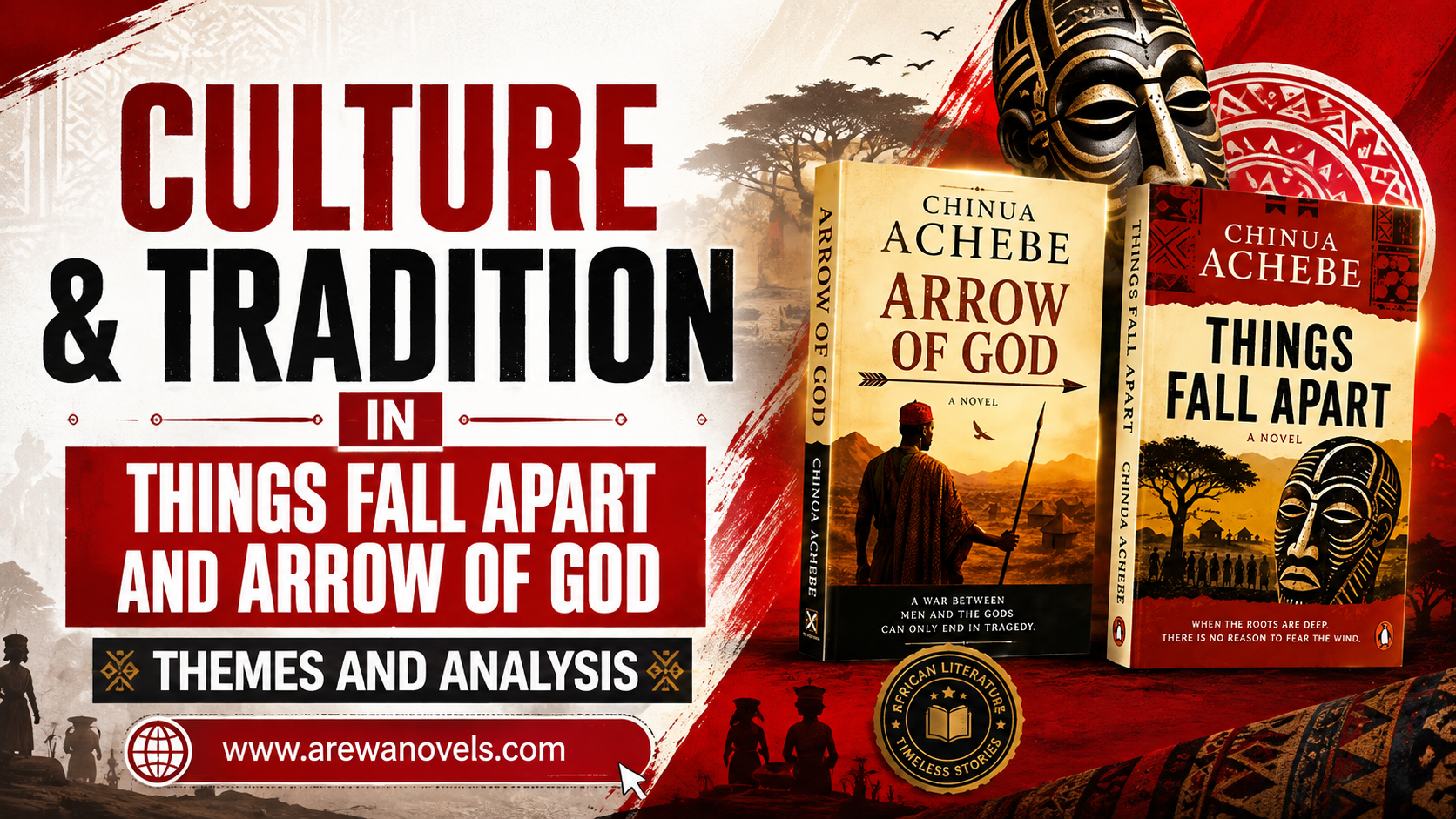
Chinua Achebe wrote two novels that ask almost the same question from two different angles. Things Fall Apart, published in 1958, and Arrow of God, published in 1964, both put a proud Igbo leader at the center of a community that colonial power is slowly reshaping. Okonkwo is a warrior whose strength becomes useless once the world changes. Ezeulu is a priest whose authority is supposed to come from a god, yet gets tested by British administrators, rival elders, and his own stubbornness at the same time.
Reading the two novels side by side shows something neither book fully shows on its own: that Igbo society before and during colonization was not one fixed thing. It had its own arguments, its own power struggles, and its own internal weaknesses, and Achebe uses both books together to give a fuller, more honest picture of a culture under pressure than either novel could give alone. This guide walks through what each book is about, why the two protagonists behave the way they do, the themes that connect the novels, and a full set of study questions for exam preparation.
Book Overview
Things Fall Apart: published 1958, follows Okonkwo, a respected farmer and wrestler in the village of Umuofia, from the height of his status through his exile and into the arrival of British missionaries and colonial officials.
Arrow of God: published 1964, follows Ezeulu, Chief Priest of the god Ulu in the six-village community of Umuaro, as he tries to defend his religious authority against a rival elder at home and a British administration that wants to turn him into a colonial puppet.
Author: Chinua Achebe, born 1930 in Ogidi, Nigeria, died 2013. Both novels belong to what is often called his African Trilogy, alongside No Longer at Ease.
Shared setting: Igbo communities in southeastern Nigeria under British colonial expansion, Things Fall Apart in the 1890s and Arrow of God roughly thirty years later, in the 1920s, when British rule had shifted from direct conquest to what colonial administrators called indirect rule, governing through local leaders rather than replacing them outright.
Shared central idea: A society with its own government, religion, and justice system is not destroyed by colonization in a single blow. It is worn down gradually, through internal division, individual choices, and a colonial system that finds and widens the cracks already present.
What Things Fall Apart Is About
Okonkwo has spent his life trying to become nothing like his father, Unoka, a gentle man who died in debt and disgrace. He builds himself into a wealthy farmer, a titled man, and a feared household head, and he treats any softness in himself or his family as a threat to everything he has built.
When Okonkwo accidentally kills a clansman at a funeral, Igbo law exiles him for seven years. He returns to find that missionaries have taken root, his own son has converted to Christianity, and the colonial administration has begun replacing Umuofia's collective justice system with courts and prisons. Okonkwo tries to rally the village to fight back, kills a colonial messenger when no one joins him, and, realizing he stands alone, hangs himself rather than face capture.
What Arrow of God Is About
Ezeulu is the Chief Priest of Ulu, a god created generations earlier to unite six villages that once fought each other. His religious authority depends on ritual precision: each month he must eat one of twelve sacred yams, and only after the twelfth can he declare the New Yam Feast that allows harvest to begin.
Years before the novel opens, Ezeulu testifies truthfully in a land dispute between Umuaro and a neighboring village, Okperi, even though the truth favors Okperi rather than his own people. This costs him support at home, particularly from a wealthy rival elder named Nwaka. The British District Officer, Captain Winterbottom, is impressed by Ezeulu's honesty and later tries to appoint him a salaried "warrant chief" over the region. Ezeulu refuses, seeing the position as a betrayal of his role as priest, and Winterbottom's administration detains him for two months as punishment.
Because of the detention, Ezeulu falls behind on eating the sacred yams. When he returns home, he insists he must still eat one yam per remaining month before calling the harvest feast, even as the community's crops rot in the fields and hunger spreads. He refuses to bend the ritual calendar for practical need, and while the crisis builds, his son Obika dies suddenly after performing a demanding nighttime ritual. The community reads Obika's death as a sign that Ulu himself has abandoned Ezeulu, and many villagers turn instead to the Christian church, which offers to accept their yams as a harvest thanksgiving. The novel ends with Ezeulu broken and Umuaro's traditional religious authority collapsing, not through direct force but through a crisis that colonial interference triggered and Ezeulu's own inflexibility deepened.
Why the Characters Behave the Way They Do
Okonkwo's behavior traces back to shame. He associates gentleness, emotion, and failure with his father, and he has built an identity entirely around proving he is the opposite. That is why he kills Ikemefuna even after being warned not to, why he cannot show affection openly even to children he loves, and why he chooses death over living in a village that no longer rewards the qualities he has spent his life perfecting.
Ezeulu's behavior traces back to something different: a belief that he is not a free agent but an instrument of his god, "an arrow in the bow" of Ulu, as the novel's title suggests. This belief lets him justify decisions that isolate him, including his truthful testimony against his own people's land claim and his refusal to adjust the ritual calendar even as his community starves. Where Okonkwo's downfall comes from personal fear, Ezeulu's comes from a conviction that his personal judgment and his god's will are the same thing, a conviction the novel slowly proves wrong.
Both men share a refusal to compromise, but Achebe gives them different reasons for it. Okonkwo cannot compromise because compromise feels like weakness. Ezeulu cannot compromise because he has convinced himself that compromise would be a betrayal of divine duty. Neither reason survives contact with a changing world.
Main Characters
Okonkwo (Things Fall Apart)
A self-made man whose fear of resembling his failed father drives him toward wealth, status, and violence in roughly equal measure. His inability to adapt once his old measures of success stop working leads directly to his suicide.
Ezeulu (Arrow of God)
The Chief Priest of Ulu, proud of his role as keeper of ritual time and deeply confident in his own judgment. His insistence on being right, whether about the land dispute with Okperi or about the yam calendar, gradually costs him the support of his own community.
Nwaka (Arrow of God)
A wealthy, titled rival to Ezeulu who openly challenges his authority and allies with the priest of a rival deity, Idemili. Nwaka represents the internal power struggles that existed in Igbo communities independent of any colonial pressure, showing that Ezeulu's authority was contested long before the British arrived.
Winterbottom and Clarke (Arrow of God)
Captain Winterbottom is the British District Officer who respects Ezeulu personally but still enforces a colonial system built on control, and his decision to detain Ezeulu sets the yam crisis in motion. His assistant Clarke inherits the same administrative machinery once Winterbottom falls ill, showing how colonial policy continues regardless of which individual official carries it out.
Obika and Oduche (Arrow of God)
Obika is Ezeulu's proud, physically striking son, well liked but reckless, whose sudden death during a nighttime ritual becomes the tragedy that breaks his father. Oduche is the son Ezeulu deliberately sends to the missionary school, reasoning that his family needs someone who understands the white man's world, a decision that backfires when Oduche, encouraged by a missionary, tries to kill a python sacred to a rival god.
Nwoye and Ikemefuna (Things Fall Apart)
Nwoye is Okonkwo's son, whose quiet discomfort with practices like Ikemefuna's killing eventually leads him to convert to Christianity and break with his father. Ikemefuna is the boy given to Umuofia to prevent a war, whose killing at Okonkwo's own hand is the clearest single act of the novel's central fear-driven cruelty.
Obierika and Akuebue
Obierika is Okonkwo's close friend in Things Fall Apart, a reflective voice who questions customs Okonkwo accepts without hesitation. Akuebue plays a similar role in Arrow of God as Ezeulu's trusted friend, someone who tries to reason with him during the yam crisis without ever fully breaking his loyalty.
Major Themes
The internal fragility of a united culture
Both novels resist the idea that Igbo society was a single, harmonious whole before colonization. Umuofia has its own outcasts and internal doubts, visible in characters like Nwoye. Umuaro is openly divided between Ezeulu's authority and Nwaka's ambition even before Winterbottom enters the picture. Achebe's point is that colonization did not simply crush a unified culture, it exploited divisions that were already there.
Individual pride against communal need
Okonkwo's pride isolates him from his own son and eventually from his village's will to resist together. Ezeulu's pride isolates him from a community that needs him to bend the ritual calendar to survive a famine he did not cause but refuses to accommodate. In both books, a leader's refusal to adapt becomes indistinguishable from the community's undoing.
Colonial power operating through disruption, not just force
Neither novel shows colonization succeeding purely through violence. In Things Fall Apart, it succeeds partly through religious conversion and economic incentive. In Arrow of God, it succeeds because a colonial administrator's decision to detain a priest sets off a chain reaction inside a ritual system the British never fully understood. Achebe is showing that colonial power's most damaging effect was often indirect: disrupting timing, authority, and internal balance rather than attacking directly.
The individual as instrument versus the individual as agent
Igbo cosmology in both novels includes ideas about personal destiny, expressed through the concept of chi in Things Fall Apart and through Ezeulu's belief that he is an arrow shot by his god in Arrow of God. Achebe uses both ideas the same way: to raise the question of how much responsibility a person bears for choices they frame as fate or duty. Okonkwo blames circumstance for pushing him toward violence. Ezeulu blames his god for decisions that were, in practice, his own.
Religion as the site of the deepest conflict
In Things Fall Apart, the clearest confrontation is the unmasking of an egwugwu and the burning of the church, both religious acts with communal consequences. In Arrow of God, the entire crisis is triggered by a religious calendar, and it ends with a religious collapse: villagers turning from Ulu to the church because the church offers a practical solution Ulu's own priest will not give them. Both novels treat religious authority as the real battlefield of colonization, more than land or law.
Major Conflicts
Things Fall Apart centers on the external conflict between Umuofia's traditional order and encroaching British colonialism and Christianity, alongside Okonkwo's internal conflict between real feeling and the hardened image he forces on himself.
Arrow of God centers on a three-sided conflict: Ezeulu against the British administration that wants to control him, Ezeulu against Nwaka and other rivals who resent his authority at home, and Ezeulu against his own community once his refusal to adjust the yam calendar puts their harvest at risk.
Read together, the two novels show colonization meeting two different kinds of local leadership, a secular strongman in Okonkwo and a religious authority in Ezeulu, and undoing both, though by different mechanisms.
Setting
Things Fall Apart is set in Umuofia and Mbanta in the 1890s, during the early years of British expansion into the Niger region. Arrow of God is set in Umuaro roughly thirty years later, in the 1920s, once the British had shifted toward indirect rule, governing through appointed local chiefs rather than direct occupation. That shift in setting matters. It lets Achebe show colonization at two different stages: its abrupt arrival in one novel and its more bureaucratic, entrenched form in the other, where the damage comes less from soldiers and more from administrators making decisions about who holds legitimate authority.
Important Symbols
Fire, associated with Okonkwo in Things Fall Apart, represents power without patience, intense but ultimately self-consuming.
The sacred yams and the ritual calendar in Arrow of God represent the precision and interdependence of Igbo religious authority. Ezeulu's refusal to adjust the calendar even during a famine shows how a single point of rigid ritual can become the mechanism of an entire community's crisis.
The python in Arrow of God, sacred to the god Idemili, represents the older, layered structure of Igbo religious life, in which multiple gods and priesthoods coexist and compete. Oduche's attempt to cage it, encouraged by the missionary Goodcountry, is a direct assault on that structure.
The egwugwu in Things Fall Apart represent collective ancestral justice, and their public unmasking by a convert is treated as an attack on the whole community's authority, not just a personal insult.
Literary Devices
Achebe relies on Igbo proverbs and oral storytelling rhythm in both novels, using them to demonstrate a sophisticated verbal culture that existed long before European contact. Both books also use foreshadowing carefully, the fire imagery around Okonkwo and the early tension between Ezeulu and Nwaka both preparing readers for the collapse to come. Irony appears sharply in both endings: the District Commissioner reducing Okonkwo's death to a paragraph in his own book, and the Christian church quietly absorbing the very harvest crisis that Ulu's own priest allowed to happen. Achebe also uses characterization through action rather than direct explanation in both novels, letting readers judge Okonkwo and Ezeulu by what they choose to do rather than by an narrator's summary of their motives.
Important Lessons From the Books
Authority that depends entirely on never bending will eventually meet a situation it cannot survive. Okonkwo's refusal to adapt costs him his life, and Ezeulu's refusal to adjust a ritual calendar costs him his community's trust in the god he serves.
A culture's own internal divisions matter as much as outside pressure in explaining how it changes. Achebe repeatedly shows rivals, doubters, and dissenters within Igbo society itself, making clear that colonization did not meet a single unified resistance in either novel.
Good judgment and rigid certainty are not the same thing. Ezeulu is often right in the narrow sense, about the land dispute, about the ritual calendar, yet being right does not protect him or his community, because leadership also requires reading what a moment actually calls for.
Religious and political power are easily entangled, and colonial administrators exploited that overlap deliberately. Winterbottom's attempt to make Ezeulu a warrant chief is not a neutral offer, it is an attempt to convert religious legitimacy into a tool of colonial administration, and Ezeulu's refusal, though it costs him personally, at least denies the British that particular tool.
Character Relationships
Okonkwo and Nwoye mirror Ezeulu and Oduche in an important way: both fathers make a decision involving a son that backfires by exposing the son to an alternative belief system. Okonkwo disowns Nwoye for converting. Ezeulu deliberately sends Oduche toward the mission, hoping to gain insight into colonial power, and instead loses some of his own family's loyalty to it.
Obierika and Akuebue serve the same narrative function in their respective novels: a loyal, reasonable friend who questions the protagonist without ever fully abandoning him, giving readers an internal perspective on Igbo society that is critical but not hostile.
Nwaka and the various figures who doubt Okonkwo, including Obierika at points, show that even the protagonists' own villages did not view them as beyond question. Achebe consistently builds friction inside the community itself, not just between the community and the colonizers.
Most Important Events to Remember
Things Fall Apart: Ikemefuna's killing, Okonkwo's accidental killing of a clansman and his exile, Nwoye's conversion, the burning of the church, the humiliation of the village leaders, and Okonkwo's suicide.
Arrow of God: Ezeulu's truthful testimony against his own people in the Okperi land dispute, Winterbottom's offer of a warrant chieftaincy and Ezeulu's refusal, Ezeulu's two-month detention, Oduche's attempt to cage the sacred python, the delayed New Yam Feast and the resulting famine, Obika's death, and the community's turn toward the Christian church.
Book Analysis
Placed side by side, these two novels argue that colonization in Igbo land did not succeed as a single, clean conquest of a unified culture. It succeeded differently in each case, and always by working through existing local structures rather than simply replacing them overnight.
In Things Fall Apart, the mechanism is social and religious conversion combined with a justice system that offers an alternative to Igbo communal law. In Arrow of God, the mechanism is more bureaucratic and, in some ways, more disturbing: a single administrative decision to detain a priest interacts with an existing rigid ritual calendar to produce a famine that the British never directly intended but that still serves their interests, since it drives villagers toward the church and weakens Ulu's authority without a single shot fired.
Scholars who have written about these novels, including the Nigerian critic Ernest Emenyonu, have described them as studies in what happens when a confident outside power meets another civilization on its own terms and refuses to recognize it as an equal. What both novels add to that argument is precision: Achebe does not simply say colonization was destructive, he shows exactly which local mechanisms, personal pride, religious ritual, generational conflict, family loyalty, it moved through to do its damage. That specificity is what makes the two books function as genuine cultural affirmation rather than simple protest literature. They do not just object to colonization, they document, in careful detail, the society it disrupted.
Study Guide
Key Facts to Remember
Things Fall Apart: published 1958, set in Umuofia and Mbanta in the 1890s, protagonist Okonkwo. Arrow of God: published 1964, set in Umuaro in the 1920s, protagonist Ezeulu. Both are part of Achebe's African Trilogy, alongside No Longer at Ease.
Important Characters to Remember
Okonkwo, Nwoye, Ikemefuna, Obierika, and Unoka from Things Fall Apart. Ezeulu, Nwaka, Winterbottom, Obika, Oduche, and Akuebue from Arrow of God.
Important Themes to Remember
The internal fragility of a supposedly united culture, individual pride against communal need, colonial power operating through disruption rather than only force, the tension between personal agency and claimed destiny, and religion as the deepest site of conflict in both novels.
Important Events to Remember
Okonkwo's exile and suicide in Things Fall Apart. Ezeulu's detention, the delayed yam feast, and Obika's death in Arrow of God.
Frequently Asked Questions
What do Things Fall Apart and Arrow of God have in common? Both follow a proud Igbo leader whose refusal to adapt contributes to his own downfall, set against the gradual encroachment of British colonial power on Igbo religious and social authority.
How are Okonkwo and Ezeulu different? Okonkwo is a secular strongman driven by fear of weakness, while Ezeulu is a religious authority driven by confidence in his own judgment and his claimed role as an instrument of his god. Okonkwo's downfall is sudden and violent, while Ezeulu's is slower and tied to a ritual crisis.
What is the main theme of Arrow of God? The fragility of religious and political authority when it depends on rigid, unbending leadership, and how colonial interference can turn that rigidity into a full community crisis.
What is the main theme of Things Fall Apart? The destructive cost of a masculinity built entirely on suppressing fear and emotion, set against the gradual, uneven arrival of colonialism and Christianity.
Why does Ezeulu refuse to become a warrant chief? Because he sees the position as turning his religious authority into a tool of the colonial administration, which he considers a betrayal of his role as priest of Ulu.
Why does the community turn away from Ulu at the end of Arrow of God? Because Ezeulu's refusal to adjust the ritual calendar during a famine, combined with his son Obika's death, convinces many villagers that Ulu has abandoned its people, right as the Christian church offers a practical alternative for their harvest.
What lessons can readers take from both novels? That leadership built entirely on inflexibility eventually meets a crisis it cannot survive, and that outside powers often succeed less through direct force and more by exploiting divisions and rigid structures that already exist inside a community.
Exam and Test Questions
Short-answer: Why does Ezeulu insist on eating a sacred yam for every month of his detention before calling the harvest feast? Answer guidance: his authority as Chief Priest depends on ritual precision, and he sees adjusting the calendar as a violation of his duty to Ulu, regardless of the community's hunger.
Character question: Compare Okonkwo's and Ezeulu's reasons for refusing to compromise. Answer guidance: Okonkwo fears appearing weak, while Ezeulu believes compromise would betray his god, and both reasons lead to isolation from their communities.
Theme question: How do both novels show that Igbo society was internally divided even before colonization intensified? Answer guidance: reference Nwoye's private doubts in Things Fall Apart and Nwaka's open rivalry with Ezeulu in Arrow of God.
Plot question: Explain how Winterbottom's decision to detain Ezeulu leads, step by step, to the collapse of Ulu's authority. Answer guidance: trace the detention, the delayed yam calendar, the famine, Obika's death, and the resulting conversions to Christianity.
Analysis question: In what ways does Arrow of God complicate or expand on the picture of colonialism given in Things Fall Apart? Answer guidance: discuss the shift from direct confrontation to indirect rule and administrative disruption, and how that changes the mechanism of cultural collapse.
Essay question: Using both novels, discuss how Achebe presents the relationship between personal pride and communal survival. Answer guidance: build a comparative argument using Okonkwo's suicide and Ezeulu's refusal to adjust the yam calendar as parallel case studies.
Essay question: To what extent do these two novels support the idea that colonization succeeded by exploiting existing divisions rather than simply overpowering a unified culture? Answer guidance: use specific examples from both books, including Nwaka's rivalry with Ezeulu and Nwoye's conversion, to argue a supported position.
Quick Revision Sheet
Things Fall Apart: Author, Chinua Achebe. Published, 1958. Setting, Umuofia and Mbanta, 1890s. Main character, Okonkwo. Main conflict, traditional Igbo life versus colonialism, mirrored by Okonkwo's fear of weakness. Key events, Ikemefuna's death, exile, Nwoye's conversion, church burning, Okonkwo's suicide.
Arrow of God: Author, Chinua Achebe. Published, 1964. Setting, Umuaro, 1920s. Main character, Ezeulu. Main conflict, religious authority under colonial and internal pressure, mirrored by Ezeulu's refusal to bend. Key events, the Okperi land dispute testimony, Ezeulu's detention, the delayed yam feast, Obika's death, the turn to Christianity.
Shared central message: A culture is rarely undone by outside force alone. It is undone when outside force finds and widens the divisions, rigidities, and personal failures already present within it.
Conclusion
Things Fall Apart and Arrow of God are often taught separately, but they were written to speak to each other. One shows colonialism arriving as a sudden disruption to a secular leader's world. The other shows it arriving a generation later as a slower, more bureaucratic pressure on a religious leader who believes his judgment and his god's will are the same thing. Together, they give a fuller argument than either book makes alone: that Igbo society was complex, divided, and fully capable of undoing itself under pressure, and that understanding colonization means understanding exactly which internal mechanisms it moved through, not just the fact that it happened.
Knowing how Okonkwo and Ezeulu compare, why each man's pride becomes his undoing, and how the two novels' colonial settings differ gives you a strong foundation for essays, discussions, or exams covering either book individually or both together.
For more comparative study guides and African literature summaries, you can browse the full collection at ArewaNovels.
Sources consulted: Britannica: Things Fall Apart and Britannica: Arrow of God