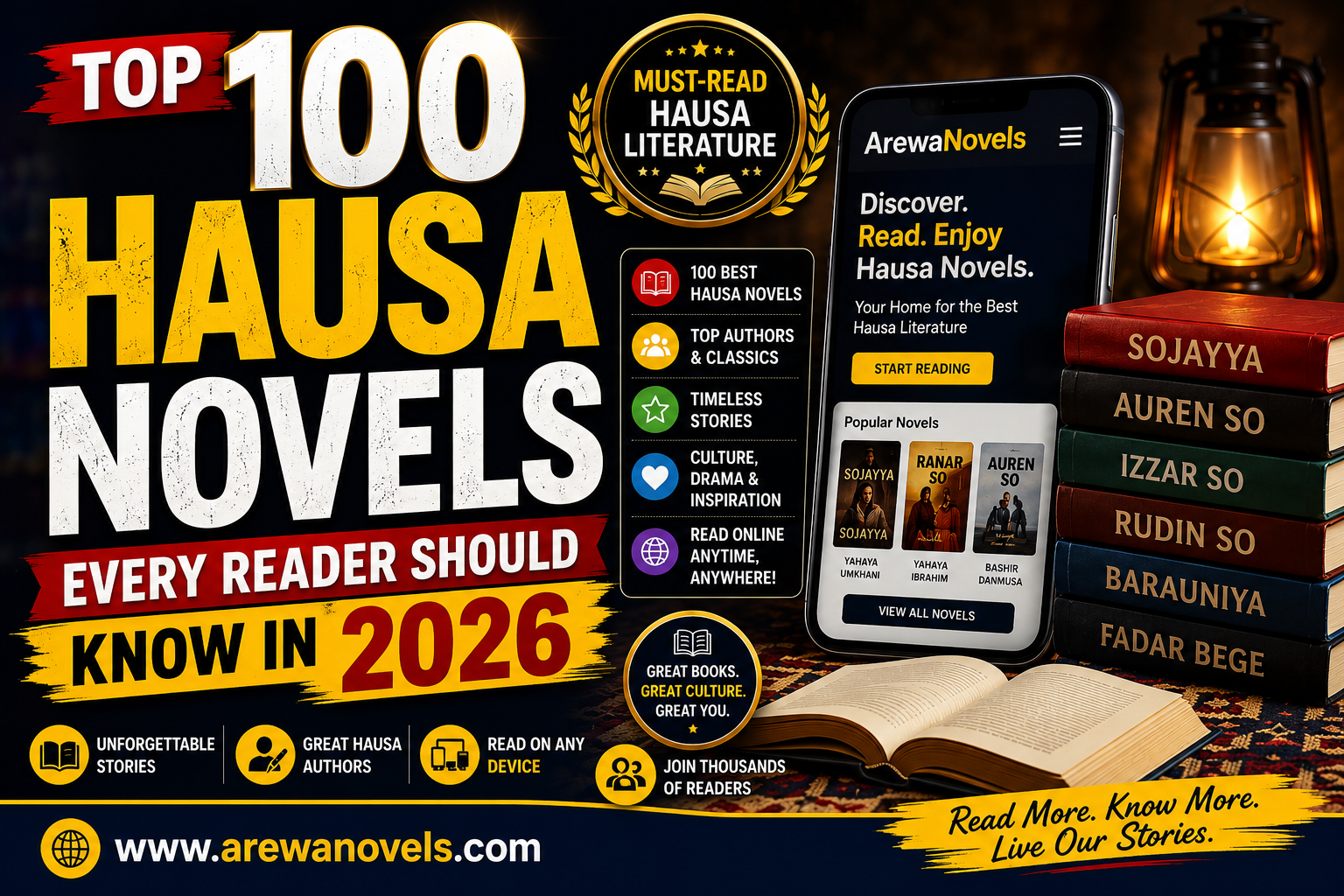
Top 100 Hausa Novels Every Reader Should Know in 2026: The Ultimate Must-Read Hausa Literature & Book List
Top 100 Hausa Novels Every Reader Should Know in 2026
Every serious reader eventually asks the question: what are the essential novels in my literary tradition? For lovers of Hausa literature, that question is more important than ever in 2026. The volume of new Hausa novels published online each year is staggering, and without some sense of a wider canon, it is easy to read only what trends in your social media feed today and miss the deeper currents of the tradition.
This article is your map to that wider canon. Rather than listing 100 specific titles in a flat ranking, it organises the most important Hausa novels into the categories, eras, and themes that have defined the tradition. The result is a guide to roughly 100 novels worth knowing, presented in a way that helps you actually find them and read them across the major Hausa novel websites in Nigeria today.
Whether you are a teenager building your first reading list, an adult reader looking to deepen your taste, or a teacher curating recommendations for students, this guide will set you on a path of meaningful Hausa reading for years to come.
How to Read This List
The "Top 100" framing is shorthand for a meaningful, balanced canon. Hausa literature is too rich for a flat list to do it justice, so the novels worth knowing are best understood by category and era. Read across the sections below, and you will encounter the kinds of stories every serious Hausa novel reader eventually comes across.
• Some are decades old, foundational works without which contemporary Hausa fiction would not exist.
• Some are modern classics from the digital soyayya era, beloved by millions.
• Some are trending novels from 2026 that are likely to join the canon in the years ahead.
• Some are quieter works, well-known to dedicated readers but less hyped on social media.
Classics That Built the Tradition
Roughly the first ten to fifteen novels in any serious Hausa canon belong to the foundational era. The Adabin Kasuwar Kano movement — Kano Market Literature — of the 1980s and 1990s produced an explosion of popular soyayya and family stories sold as cheap printed booklets in markets across Northern Nigeria. These novels created the templates that everything since has either followed or reacted against.
Ado Ahmad Gidan Dabino's In Da So Da Ƙauna is perhaps the most famous single example. Published in the early 1990s, it became a defining popular romance and helped legitimise soyayya as a serious commercial genre.
Balaraba Ramat Yakubu's Alhaki Kuyangin Yake (Sin is a Puppy That Follows You Home) brought attention to women's experiences in Northern Nigeria with remarkable honesty. It has since been translated into English and is studied around the world.
Hafsat Abdulwaheed's So (Love) is often cited as a pioneering Hausa fiction work by a woman to win significant national recognition, opening doors for the wave of female Hausa writers that followed.
Bilkisu Funtuwa is another name no Hausa reader should miss. Her prolific output through the soyayya era helped establish the commercial and cultural viability of the modern Hausa novel.
Beyond these named figures, a wider community of writers produced hundreds of popular novels through the 1980s and 1990s. Together, their work forms roughly the first quarter of any honest Top 100 Hausa novel list.
To find older and classic Hausa novels online, browse the archive sections of WikiNovels, NovelPedia, and HausaNovels.net.ng. These platforms often preserve work that newer trending-focused sites overlook.
Iconic Soyayya Novels Worth Knowing
If the foundational classics make up roughly the first fifteen of the Top 100, the next thirty or so belong to iconic soyayya novels. These are the love stories that have shaped how millions of Hausa readers think about romance.
Across the soyayya canon, certain types of stories appear repeatedly. Each represents a sub-genre with its own beloved titles.
• Classic first-love stories. Innocent, sometimes naive, often heartbreaking. These are usually a reader's first encounter with Hausa romance.
• Arranged marriage narratives. Couples brought together by family find their way to genuine love (or do not). The tension between duty and feeling defines this sub-genre.
• Polygamy stories. First wives, second wives, and the children caught in between. Modern Hausa novels handle polygamy with much more nuance than older works did.
• Second-chance romances. Divorcées, widows, and ex-couples find love again. This sub-genre has exploded in popularity in recent years.
• Forbidden love. Across class, family rivalry, or unusual circumstances, these stories test what love can survive.
• Long-distance and diaspora love. Increasingly common as Hausa speakers travel for school and work.
• Workplace romance. Heroines balancing demanding careers with relationships. A defining feature of modern soyayya.
• Hidden-identity romance. A heroine falls in love before discovering the truth about her partner's wealth, family, or past.
The best places to read iconic soyayya novels online are Soyayya Novels, Arewa Novels, TKNOVELS, Fitattun Novels, and Hausa Novels R.
Family Drama Novels Every Reader Should Read
If soyayya is the heartbeat of Hausa literature, family drama is its quieter, steadier pulse. About fifteen to twenty novels in a Top 100 should belong to this category. These stories deal with the realities of marriage, parenting, in-law relationships, sibling rivalries, and the slow accumulation of decisions that define a household over decades.
Family drama novels often deal with:
• Mother-in-law tensions and the quiet diplomacy required to manage them.
• Co-wife dynamics and the children who must navigate between mothers.
• Sibling rivalry over inheritance, attention, or perceived favouritism.
• The reintegration of a returning migrant relative.
• Caring for ageing parents.
• Marriages strained by infertility, illness, or financial collapse.
• The aftermath of divorce, especially when children are involved.
• Step-parenthood and blended families.
Family drama novels rarely trend like soyayya, but they often produce the books readers remember most vividly years later. They speak directly to the texture of real life and reward thoughtful reading.
Islamic Hausa Novels of Lasting Impact
Roughly ten to fifteen novels in a Top 100 list should belong to the Islamic category, broadly understood. These are not sermons in fiction form. They are stories in which faith is woven naturally into the characters' lives, shaping their choices, struggles, and growth.
Major themes in Islamic Hausa novels include:
• Halal courtship and marriage. Stories of believers finding partners in line with their values, sometimes against pressure from a more secular environment.
• The journey of repentance. Characters whose past choices haunt them and who learn what genuine return to faith feels like.
• Studying Islamic knowledge. Stories of young hafiz, talibu, and women pursuing serious religious study.
• Family life through a faith lens. Marriage, parenting, in-law relations, and divorce explored through the rights and responsibilities Islam outlines.
• Migration and faith. Hausa Muslims abroad navigating new cultures while holding on to their identity.
• Charity, community, and social responsibility. Stories of individuals quietly transforming their neighbourhoods through faith-driven action.
Strong Islamic Hausa novels can be found across Arewa Hausa Novels, WikiNovels, Fitattun Novels, and Hausa Novels R.
Inspirational Hausa Novels That Changed Lives
Around eight to ten novels in any Top 100 should belong to the inspirational category. These are the stories readers reach for when life feels heavy. They follow characters who rebuild after setbacks, choose integrity in difficult moments, and quietly become the version of themselves their younger selves dreamed of.
Common themes include:
• Women returning to school after marriage, divorce, or motherhood.
• Young men choosing honest work over easy money.
• Families surviving illness, loss, or financial collapse.
• Entrepreneurs building businesses from nothing.
• Survivors of abuse finding their way to safety and self-respect.
• Migrants succeeding abroad while staying connected to their roots.
Inspirational Hausa novels rarely shock or provoke. Their power is cumulative, leaving you a little stronger, kinder, and more determined.
Contemporary Youth-Focused Hausa Novels
Roughly ten novels in the Top 100 belong to youth-focused Hausa literature. These stories speak directly to teenagers and young adults navigating school, friendship, family expectations, and first love.
Themes include:
• Boarding school dynamics and friendship rivalries.
• Examination pressure and the path to university.
• Social media bullying and online drama.
• First crushes and the moral weight Hausa culture places on them.
• Conflict between modern aspirations and family expectations.
• Sibling support and rivalry among young adults.
• Identity-building during the transition from school to working life.
Youth-focused Hausa novels are particularly well represented on KDP Novels, BookTok Novels, and Read Hausa Novels.
Educational and Historical Hausa Novels
About five to ten novels in any Top 100 should belong to the educational and historical category. These are books that quietly teach as they entertain. They explore real events from Northern Nigerian history, illuminate scientific or social concepts through story, or follow characters whose journeys map onto important social issues.
• Stories set during the founding or development of major emirates.
• Novels exploring the colonial encounter and its aftermath.
• Health-focused fiction that quietly informs readers about diseases, pregnancy, and well-being.
• Stories celebrating girls' education and women's participation in professional fields.
• Novels engaging with environmental, agricultural, or community development themes.
• Lightly fictionalised biographies of historical or composite figures from Northern Nigeria.
Trending 2026 Novels Joining the Canon
Finally, no honest Top 100 of Hausa novels would be complete without recognising the most exciting newcomers of 2026. These are the trending titles that may well be regarded as future classics.
Trending novels of 2026 are concentrated in specific themes:
• Modern polygamy stories told with new emotional depth.
• Diaspora love stories spanning Saudi Arabia, the UK, the US, and Canada.
• Heroines balancing high-pressure careers with romantic lives.
• Post-divorce romances featuring mature, self-aware protagonists.
• Faith-and-love stories that take both seriously.
• Cross-cultural romances between Hausa characters and partners from other African and global backgrounds.
To stay current with the novels likely to join the canon next year, regularly browse the trending sections of BookTok Novels, TKNOVELS, Arewa Novels, and Soyayya Novels.
How to Read Through the Top 100 Hausa Novels
Reading 100 Hausa novels might sound overwhelming. It is not, once you have a plan.
1. Aim for roughly two Hausa novels a month. That gives you 24 a year, and 100 across four years.
2. Rotate categories. Move between classics, soyayya, family drama, Islamic, inspirational, and youth-focused titles to keep your reading rich.
3. Mix old and new. Pair a foundational classic from the 1990s with a trending novel from 2026. The conversation between eras is illuminating.
4. Keep a notebook or digital list. Note each title, author, platform, and a one-line reaction. You will love revisiting this list years later.
5. Reread occasionally. Some Hausa novels deserve at least two readings. The first time you read for plot, the second for craft.
6. Share as you go. Recommend one book a month to a friend. The Top 100 grows when you bring others into it.
7. Be patient. Building a serious literary education takes time. Two or three years from now, you will have a depth of Hausa reading most people never reach.
Frequently Asked Questions
Is there an official Top 100 Hausa Novels list?
No single official list exists, partly because Hausa literature is still being actively written and partly because critical consensus varies. The framing here is a practical canon assembled from the categories and eras that any serious Hausa reader will eventually engage with.
Where can I find older classic Hausa novels online?
WikiNovels, NovelPedia, HausaNovels.net.ng, and Hausa Novels R often preserve older titles. Some classics are also available in print through traditional booksellers and through select Amazon Kindle editions.
How do I know if a Hausa novel deserves to be considered a classic?
Look for novels that are still being recommended years after their original release, that are referenced by other writers and critics, that have been translated or adapted, and that continue to attract new readers across generations.
Are there Hausa novels translated into English on this list?
Yes. Notably, Balaraba Ramat Yakubu's work has been translated into English. A handful of other titles have appeared in translation on platforms like Amazon Kindle. For most, the original Hausa version remains the most powerful experience.
Which category should I start with?
Most readers find soyayya the easiest entry point because its emotional stakes are universal. Once you have read several romance novels, branch out into family drama and inspirational titles to balance your taste.
Can I find Hausa novels on global platforms like Goodreads or Wattpad?
Yes, but in smaller numbers. Wattpad, Goodreads, Amazon Kindle, Scribd, and Storytel occasionally feature Hausa or Hausa-related titles, particularly translations and diaspora works. For depth, dedicated Hausa novel websites are far stronger.
How long will it take me to read 100 Hausa novels?
At two novels per month, about four years. At one novel per week, about two years. Either pace will leave you with a remarkable literary education in Hausa fiction.
Final Thoughts
A Top 100 Hausa novel reading project is one of the most enriching commitments you can make to your own life. It will deepen your understanding of the language, your appreciation of the culture, and your relationship to the writers carrying this tradition forward.
Open Arewa Novels, Soyayya Novels, WikiNovels, NovelPedia, or any of the platforms above, pick your first title, and begin. Read across categories. Read across eras. Read across regions. By the time you finish, you will not just have read 100 Hausa novels. You will have built your own canon.
And once you have, you will be the person other readers come to for recommendations. That is one of the quiet joys of being a serious Hausa novel reader in 2026.